Cutlery Logo Artwork: A Placement Handoff for Private-Label Buyers
· Yumingxing
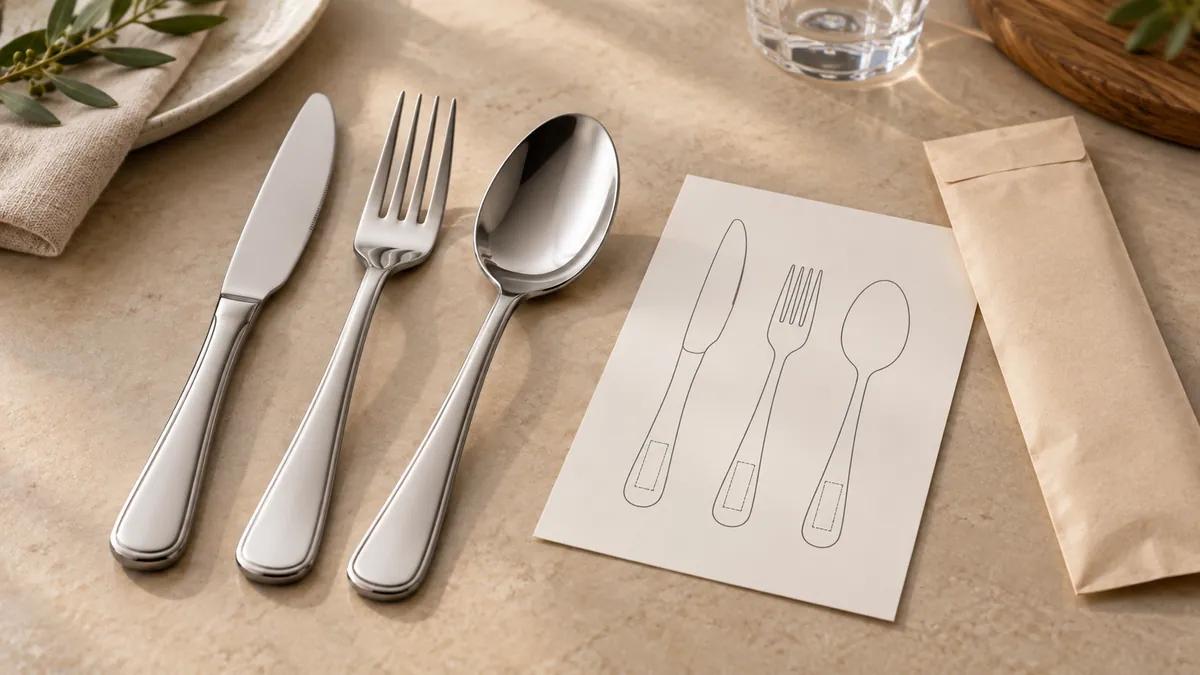
The cover is a generated editorial illustration. Its blank placement diagram is not an approved Yumingxing production drawing or a customer logo.
“Put our logo on the handle” leaves several open decisions: which utensil, which face, where on the handle, how large, and which artwork version. A private-label buyer can reduce ambiguity by sending a component-by-component placement brief before requesting a proof or sample. This guide concerns the handoff of branding information, not a promise that a particular mark can be applied to every model.
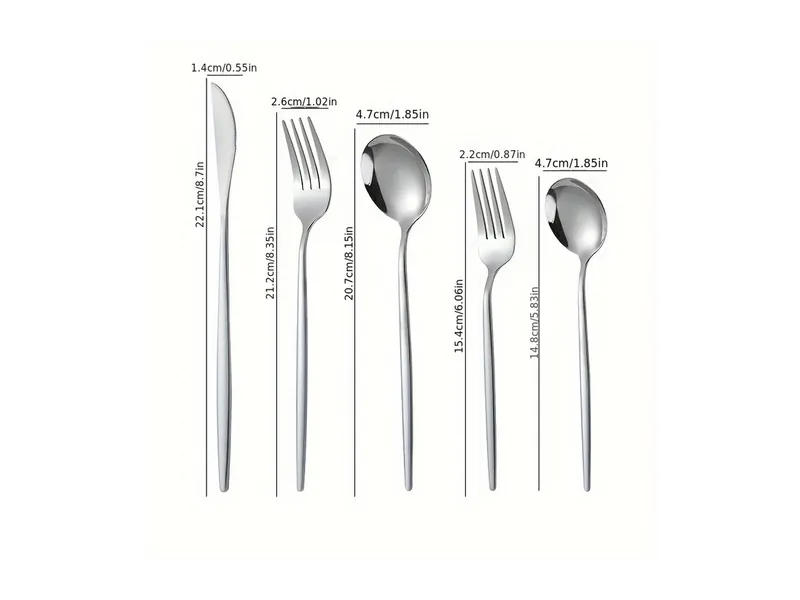
Yumingxing’s OEM/ODM page and Portuguese-style five-piece catalogue model allow logo enquiries. Availability, method and workable mark area still need confirmation for the selected piece and finish. The general cutlery RFQ guide covers the wider order; the sheet below deals only with the artwork and placement decision.
Identify every marked component
Do not label a whole assortment “logo on set.” List the dinner knife, dinner fork, dinner spoon and any smaller pieces separately. Some may carry a mark while others remain plain. For each marked component, give the catalogue model or approved sample ID and a drawing or annotated photograph showing the exact side and orientation. A mark that looks centred on a fork may not sit identically on a knife handle.
| Handoff field | What the buyer should provide or request |
|---|---|
| Product and component | Model, version and the specific knife, fork or spoon. |
| Artwork identity | Brand owner-approved file name, revision and colour/monochrome intent. |
| Placement | Marked drawing with face, orientation, position and intended size. |
| Surface context | Agreed finish and whether the surrounding surface must remain unchanged. |
| Supplier feasibility | Accepted file format, method, available area and any limits for this component. |
| Approval evidence | Proof revision, sample ID, approver and date of decision. |
The field list is an editorial tool. It does not define a universal engraving size, file format or marking method.
Use one revision trail
Send the editable artwork in the format the supplier requests, accompanied by a visual reference that cannot be mistaken for a second “final” design. Mark superseded versions clearly. When the supplier returns a proof, compare the actual component, mark orientation, scale and position against the latest brief. Check whether the proof covers both the utensil and any branded retail packaging; these are separate surfaces and may need separate artwork approvals.
Record the outcome as approved, revise or not evaluated for each component. If only the dinner spoon proof is approved, the knife and fork remain open. Before bulk approval, match the accepted proof or physical sample to the order revision; the broader sample approval guide explains how to retain that record. Changes to the product shape, finish or packaging should trigger a new feasibility and artwork check instead of silently inheriting an earlier logo approval.
Ask through the enquiry page which components and logo routes are feasible for your model, and request written confirmation of the proof process, MOQ, cost and timing. Do not assume these terms from a catalogue image.
Sources and limits
- Yumingxing OEM/ODM page — logo customization can be discussed; checked 2026-09-30.
- Portuguese-style five-piece catalogue model — a model reference for logo enquiry; checked 2026-09-30.
This placement sheet is an editorial procurement aid. It does not reproduce customer artwork, claim an approved production mark or guarantee a specific marking technique.