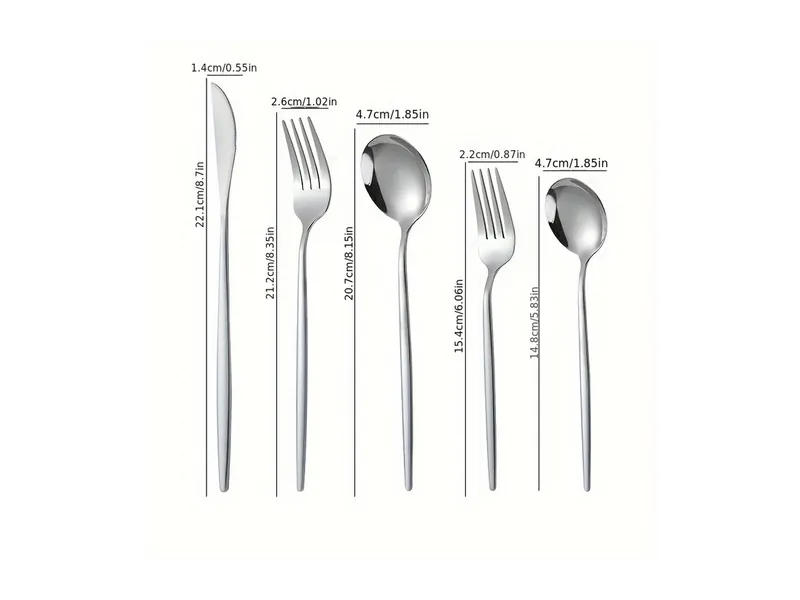
Two Languages on One Cutlery Pack: Approve the Meaning Before Print
· Yumingxing
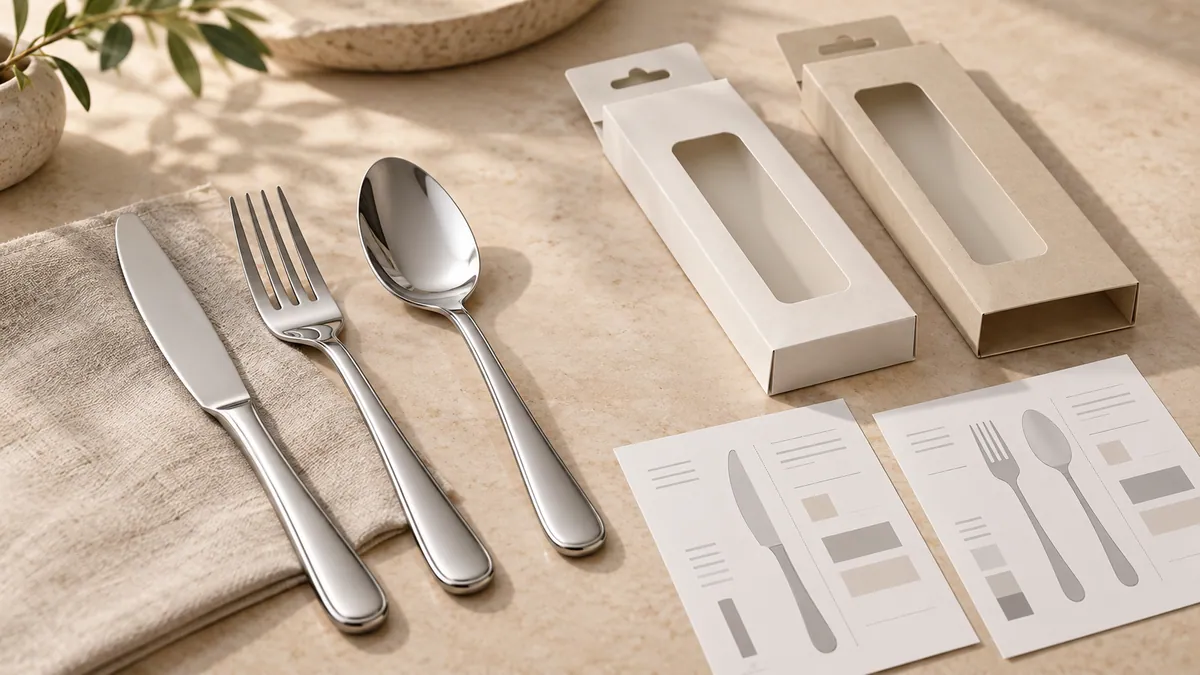
The cover is a generated editorial illustration, not a Yumingxing SKU or an approved printed pack.
A private-label cutlery sleeve can be visually balanced while its two language panels describe different products. One panel may say “five pieces,” while the other implies five place settings; a translated care sentence may become a stronger claim than the approved original. Before releasing artwork to print, the buyer should compare meaning, numbers and the exact sellable unit across every language. A spelling check alone will not catch those differences.
The Yumingxing cutlery RFQ guide asks buyers to specify the component mix, finish, packaging and production artwork. Its care-claim approval guide treats cleaning language as a product claim requiring support for the actual configuration. These are starting points for an artwork proof, not evidence that a particular translation or market label has been approved.
Build one bilingual proof card per sellable pack
| Proof field | Compare on both language panels | Evidence or decision to retain |
|---|---|---|
| Pack identity | Model reference, set name, sellable-unit definition and artwork revision | Approved order specification and pack mock-up |
| Contents | Piece names, count of each utensil and total pieces versus place settings | Approved component list and physical sample |
| Material and finish | Whether each translated statement describes the same components and finish | Component-specific specification; remove unsupported generalizations |
| Care and performance | Scope and strength of cleaning, durability or other claims | Claim evidence for the exact product; unresolved text stays off the proof |
| Measures and quantities | Units, decimal separators, pack count and any dimensions | Checked values with a named measurement orientation |
| Brand and code | Name, logo version and the code assigned to that retail unit | Brand owner’s approved files and code record |
| Sign-off | Language reviewer, product checker, final file version and date | One controlled print-ready file and change record |
Give the translator the approved product sheet and a photograph or mock-up of the actual packed unit. Ask for a back-translation or plain-language explanation of any sentence that changes the scope of a claim. The buyer, not just the language reviewer, should decide whether the statement is supported. Keep regulatory or retailer-required wording as an open item for the destination market’s qualified reviewer; this worksheet is not a legal label approval.
Compare the printed proof with the controlled file
After text approval, inspect a full-size proof in the intended folding and display orientation. Check that no language panel is hidden by a flap, cut through a window, or paired with the wrong variant. Match the proof’s revision to the purchase order and the approved sample before authorizing printing. If a component, care claim or pack count changes, reopen both language panels; changing only the original-language sentence can leave the other panel inaccurate.
The release decision should name the exact file and pack version, list any unresolved market checks, and state who can authorize the print run. It does not imply that a particular Yumingxing pack, translation, material claim or destination-market label has been verified.