Pieces, Sets and Cartons: A Flatware Order Check for Mixed SKUs
· Yumingxing

Cover image is a generated editorial illustration, not an actual packed order or Yumingxing product photograph.
A flatware purchase order can look consistent while asking for three different quantities. “1,000 sets,” “5,000 pieces” and “84 cartons” describe the same shipment only if the composition and carton pack have been agreed. For a supermarket or wholesale buyer handling multiple SKUs, put a unit of measure and conversion factor on every order line before approving the quantity.
This is an order-reconciliation guide. The earlier packaging brief explains retail boxes and shipping cartons; here the decision is whether the purchase order, supplier confirmation and receiving count describe the same goods.
Choose the orderable unit for each SKU
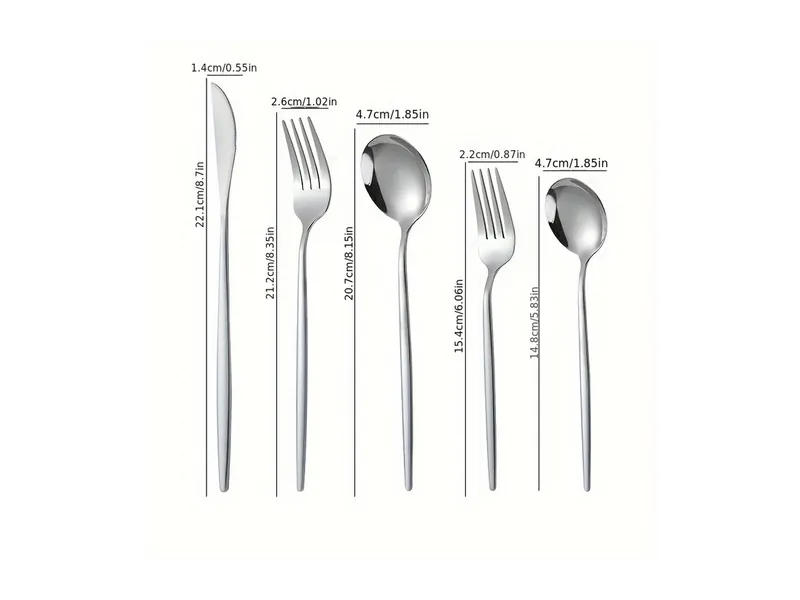
Start with the unit the buyer will sell or replenish. A retail SKU might be one boxed set; a service replacement SKU might be one loose fork. Keep those lines separate even if both belong to the same pattern. The Yumingxing Portuguese-style five-piece set provides a catalogue example: dinner knife, dinner fork, dinner spoon, salad/dessert fork and dessert spoon. Confirm the actual packing for a proposed order; the catalogue composition does not establish how many sets fit a carton.
For each line, record the set composition and three distinct counts: pieces per sellable unit, sellable units per shipping carton and ordered cartons. Add a variant identifier for finish or artwork. “Set” without its component list is not a complete unit definition.
GS1’s Package and Product Measurement Standard, release 3.3, covers measurement information across consumer units, cases and intermediate packaging levels. Its scope supports keeping packaging levels explicit. The arithmetic worksheet below is our editorial method, not a GS1-prescribed order quantity, and a retailer’s own data or identification requirements need separate confirmation.
Run the arithmetic per line, then reconcile the whole order
The following is a hypothetical example, not Yumingxing packing data or a real order. Suppose SKU A is a five-piece retail set packed 12 sets per shipping carton. The buyer asks for 1,000 sets. SKU B is a replacement dinner fork packed 48 loose forks per carton, and the buyer asks for 240 forks.
| Line | Requested sellable units | Assumed carton pack | Whole cartons | Quantity represented | Difference to request |
|---|---|---|---|---|---|
| A: boxed five-piece set | 1,000 sets | 12 sets/carton | 83 cartons | 996 sets = 4,980 pieces | 4 sets short |
| A: alternative full-carton choice | 1,000 sets | 12 sets/carton | 84 cartons | 1,008 sets = 5,040 pieces | 8 sets extra |
| B: loose replacement fork | 240 forks | 48 forks/carton | 5 cartons | 240 forks | Exact |
Do not quietly change A to 84 cartons. The buyer and supplier must agree whether to accept eight extra sets, use a permitted part carton, or change the carton configuration or order quantity. A claim that 1,000 sets equals 84 cartons would hide the overage. When A uses 84 cartons and B uses five, the shipment has 89 cartons and 5,280 individual pieces; it still has two SKU lines, not one interchangeable “5,280-piece set.” Carton dimensions and weights must be taken from each actual packed SKU before a volume or freight calculation.
For each SKU, use these checks:
confirmed sellable units = confirmed cartons × sellable units per carton, plus any separately approved part-carton units;component count = confirmed sellable units × pieces of that component per sellable unit;difference = confirmed sellable units − requested sellable units.
The component calculation matters for a mixed set. If the agreed five-piece composition has one of each named item, 1,008 sets require 1,008 of each component, not merely 5,040 assorted pieces. A shortage in one fork type cannot be concealed by extra spoons.
Put the conversion on the PO and receiving record
| Field to preserve | Why it matters |
|---|---|
| SKU and variant, including finish or logo revision | Prevents a carton count from being applied to the wrong product. |
| Sellable unit and component composition | Defines what “one set” or “one piece” means. |
| Units per carton and whether part cartons are allowed | Makes whole-carton rounding visible. |
| Requested, confirmed and shipped quantities in the same unit | Shows approved changes and any shortage or overage. |
| Carton marks or identification used for receiving | Lets the receiving team reconcile physical cartons to each line. |
| Packed dimensions and gross weight by SKU | Supports later logistics calculations without treating quantities as volume or weight. |
At receipt, count cartons by SKU, then open or inspect cartons according to the agreed receiving procedure to verify the pack factor. A correct grand total of cartons does not prove that the assortment is correct. Keep the supplier’s revised confirmation and any approved quantity change alongside the purchase order.
To prepare a Yumingxing order, send the catalogue model or reference image, sellable-unit definition, quantity by SKU, proposed carton pack and destination through the enquiry page. Ask for the actual packing and any full-carton adjustment to be confirmed in writing before approving the PO.
Sources and limits
- Yumingxing five-piece product page — catalogue composition; checked 2026-09-29. No carton pack or stock quantity is inferred.
- GS1 Package and Product Measurement Standard, release 3.3 — scope of packaging levels and measurement communication; checked 2026-09-29. The example counts and formulas are editorial, not a quotation or GS1 rule.