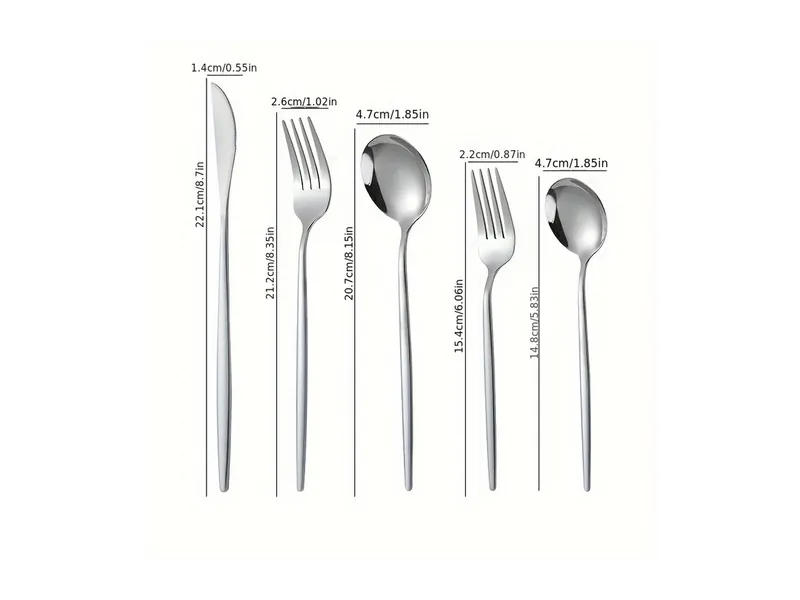
Approve a Dinner Knife for the Meal, Not Just the Set Photo
· Yumingxing
The cover is a generated editorial illustration, not a Yumingxing production sample or a knife-performance test.
A dinner knife may complete a set visually but still need checking against the food, plates and handling expected in service. A catalogue photo cannot establish how a particular knife feels in use or whether its proposed blade suits the buyer’s menu. Approve the actual proposed knife sample with the intended meal and matching fork before committing to a bulk cutlery order. This is a trial plan, not a cutting-performance claim about any Yumingxing model.
Yumingxing’s Portuguese-style five-piece catalogue set includes a dinner knife along with forks and spoons. Its cutlery collection guide says to confirm the specification of each component rather than assuming the set name defines every piece. The pages do not publish an acceptance limit for cutting performance or identify the exact blade of an unconfirmed order.
Give the sample a defined task
| Field | Buyer records | Sample check |
|---|---|---|
| Knife identity | Model, blade profile, sample revision | Keep approval linked to one physical knife |
| Intended meal | Representative foods and preparation | Try ordinary dining motions with the intended fork |
| Plate and setting | Plate shape, surface and usual placement | Check the knife and fork together at the table |
| Blade observation | Edge profile, tip, contact and user feedback | Record observations without claiming a laboratory result |
| Handle | Grip, overall length, balance and clearance | Have intended users handle the sample |
| Material and finish | Agreed specification for the knife itself | Request component-specific documents where needed |
| Release | Approver, date, sample ID and open questions | Resolve deviations before the production version is agreed |
Do not judge a knife from one easy food alone if the menu includes several preparation types. Record the selected tasks, how the team used the knife, and any disagreement among reviewers. A separate test method and agreed criteria are needed if the purchase order requires a measurable cutting result. An informal restaurant trial should not be written up as a certified sharpness or safety test.
The knife may use a different component specification from the fork or spoon. Confirm material, surface treatment and care requirements for that knife rather than transferring a statement about another piece. Appearance is also not evidence of food-contact compliance or dishwasher performance. Ask for documents relevant to the chosen configuration and destination when those claims matter.
Send the approved knife identifier, trial notes, matching fork reference and any formal acceptance method with the RFQ or order. If the blade, handle or menu reference changes, repeat the affected checks. The result is a reproducible buying decision grounded in a sample and a defined use, not a promise derived from a set photograph.