US Flatware Procurement: A Market Study for Supermarkets and E-commerce Buyers
· Yumingxing

Research accessed 29 October 2026. This is public-source desk research, not store visits, a consumer survey or a supplier quotation. The cover is an AI-generated editorial concept, not a photograph of a sampled SKU or Yumingxing production.
For a US flatware launch, select the channel economics before expanding the assortment. The listings studied here repeatedly offer 20 pieces for four people, yet the public asking prices, material disclosures and delivery conditions differ substantially. A large supermarket needs a sellable box that earns its shelf space; an online seller also needs enough contribution after parcel fulfilment, advertising and returns. Those are related but different buying decisions.
This first country study combines 2023–2025 UN Comtrade records, US Census retail context, twelve product pages across Target, IKEA US, Walmart.com and Wayfair, and primary regulatory sources. Target and IKEA provide large physical-chain references; Walmart.com and Wayfair provide two distinct online sales channels. All product observations were made online. They establish catalogue offers, not nationwide store distribution, actual selling prices or sell-through.
1. Trade indicates an import opportunity, not the size of the stainless-steel market
The table uses US imports, reporter 842, annual goods data, HS classification H6, world partner 0 and China partner 156. Values are the API’s primaryValue, in USD millions; weights are net kilograms converted to million kg. The response contains aggregated/processed records, and primaryValue matches its CIF field; the separately returned FOB field is different. Do not compare these figures unadjusted with a US customs-value series.
| Year | HS8215 world value | China value / share | World net weight | HS8211.91 world value | China value / share | World net weight |
|---|---|---|---|---|---|---|
| 2023 | 445.26 | 306.51 / 68.8% | Not available | 92.14 | 60.82 / 66.0% | 8.21, estimated |
| 2024 | 477.74 | 335.11 / 70.1% | 47.45, estimated | 83.34 | 54.20 / 65.0% | 8.35, estimated |
| 2025 | 581.90 | 426.45 / 73.3% | 58.51, estimated | 88.42 | 50.79 / 57.4% | 8.81, estimated |
Source queries: 2023, 2024, 2025. Rounded shares are calculated from the unrounded values.
HS8215 covers assorted base-metal table/kitchen utensils and sets, rather than stainless-steel consumer flatware alone. Table knives also require examination under HS8211.91. Keep the two series separate: neither captures domestic production, retail margins or household purchases, and a set’s classification must be established from its actual contents. The UN classification and current US tariff schedule are classification references, not market-size estimates.
The value pattern supports investigating replenishable imported ranges, but does not demonstrate consumer demand growth. Changes in product mix, inventory timing and valuation can also change import values. China’s share moves differently in the two headings; buyers should assess dependence at component and supplier level, not apply one country share to every knife, fork and spoon. A direct Census trade-API cross-check failed during this research, so reconciliation to the national customs-value series remains open. No missing weight was replaced with zero or converted into a number of retail sets.
For channel context, the Census release dated 18 August 2026 estimated Q2 e-commerce at USD340.2 billion, or 17.1% of total retail, seasonally adjusted. The same page now flags those estimates as superseded and says revisions will appear in the 19 November release. They are historical release figures, not the latest revised estimate and not flatware statistics. This supports examining both channels without assigning a national cutlery sales split. Census release and revision notice.
2. What twelve public listings actually show
Prices below are USD listing snapshots accessed on the research date. Some retrieved pages were cached days or weeks earlier. Tax, shipping, membership offers and local availability are not standardized. “Stainless” and composition grades are seller claims, not laboratory verification. A missing package dimension or grade is a sourcing question, not evidence of absence.
| Channel / linked SKU | Pieces / people | Displayed USD | Material disclosure | Availability or comparison limitation |
|---|---|---|---|---|
| Target Ashby 85123311 | 20 / 4 | 39.00 | 18/0 | In-stock label; no particular store verified |
| Target Millinocket 85192960 | 20 / 4 | 39.00 | 18/0 | In-stock label; no particular store verified |
| Target Kayden 14152120 | 20 / 4 | 49.00 | 18/0 | In-stock label; mirror finish |
| Target Newfane 85268102 | 45 / conflicting fields | 40.00 clearance; regular 80.00 | 18/0 | Description says 8 people; specification says 4; exclude from normalized comparison |
| IKEA 365+ 203.997.58 | 20 / 4 | 29.99 | Stainless; grade unspecified | Delivery/collection requires location; latest opened page replaces an older conflicting price |
| IKEA BEHAGFULL 003.042.33 | 20 / 4 | 59.99 | Stainless; grade unspecified | Local availability not resolved |
| IKEA SEDLIG 201.553.12 | 20 / 4 | 69.99 | Stainless; grade unspecified | Local availability not resolved |
| Walmart Mainstay mirror 18860852067 | 20 / 4 | 12.48 | 18/0 in key features | Walmart seller; shipping and pickup shown for 85001 |
| Walmart Connor 16594903 | 20 / 4 | 12.24 rollback; previously 13.97 | Stainless; grade unconfirmed | Older page snapshot; other page cross-sell shows 12.48; exclude from current price-band comparison |
| Walmart Bamboo 946535994 | 20 / 4 | 12.48 | Stainless; grade unconfirmed beyond AI summary | Walmart seller; shipping shown to 95829, local delivery unavailable |
| Wayfair Fortessa Metropolitan FTSA1228 | 20 / 4 | 220.00 | 18/10 | Add-to-cart and delivery to 50309 shown; member incentives excluded |
| Wayfair Pfaltzgraff Vienna PFZ2384 | 20 / 4 | 22.99 sale; reference 97.99 | 18/0 | Cannot ship to the displayed 78205 ZIP; not an available delivered-price benchmark |
The recurring five-component, four-person set is a sensible initial test hypothesis, not proof that it is America’s best-selling format. Likewise, the same 18/0 label appears at several asking prices; grade alone cannot explain price positioning. Brand, shape, finish and commercial terms need separate comparison. Do not use the USD220 listing as evidence that a new private label can command that price, or a clearance price as a sustainable shelf-price target.
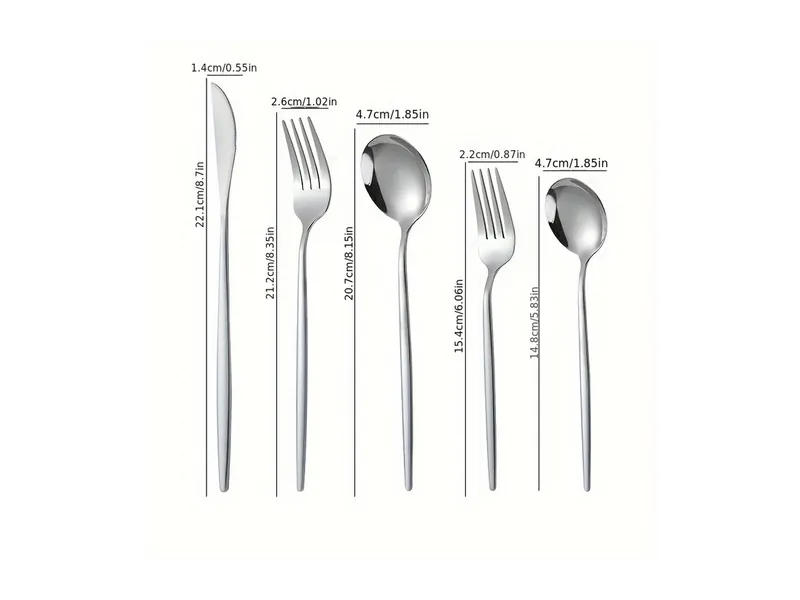
Packaging is a measurable difference. Target lists estimated shipping sizes of 3.11 × 6.87 × 11.09 inches for Ashby and 3.1 × 6.97 × 10.74 for Kayden, with weights of 2.79 and 3.26 lb. IKEA lists one package per BEHAGFULL set, 7¼ × 2 × 9½ inches and 2 lb 13 oz; SEDLIG is 7 × 2¾ × 10 inches and 2 lb 8 oz. These are different merchants’ shipping/package fields, not comparable master-carton specifications. They illustrate why a supplier must quote the finished sellable unit and the shipping overpack separately. Sources are the linked product pages above.
3. Supermarket buyers: build a shelf test with controlled variants
Start with a small range organized around a clear purchase reason: an accessible everyday set, a differentiated handle or finish, and a larger hosting format only after its component count is reconciled. This is our inference from the samples, not a recommendation for a fixed nationwide price ladder. Target’s two USD39 sets illustrate that design alternatives can occupy the same public price point; the Newfane discrepancy shows why “pieces” and “people served” must be checked independently.
For each candidate, request a five-component bill of materials, piece dimensions and mass, finish reference, care instructions and approved production sample. Record the knife’s steel separately from the spoon and fork. An 18/0 or 18/10 headline on a retailer page does not establish the metallurgy of every component in a proposed OEM order.
Approve the retail box using the intended shelf or peg arrangement. The pack should show the full contents clearly, allow the customer to identify the pattern, and protect polished surfaces. Confirm readable identification, origin information and any applicable disclosures before artwork is locked. Ask the chain for its barcode, outer-case, pallet and receiving requirements; a product page does not disclose those vendor requirements.
Replenishment must be in sellable sets per store, with a separate conversion to inner packs and outer cartons. A buyer planning rule is weekly set sales × replenishment lead time in weeks + safety stock − usable stock − confirmed inbound sets. Use the chain’s real sales and lead-time data; this study does not supply them. Review stockouts, markdowns and component defects by SKU before extending to more stores. A cheap set requiring frequent markdowns or receiving corrections can be a worse purchase than a higher-cost stable line.
4. E-commerce sellers: qualify the delivered unit and its contribution
Keep the consumer’s order unit explicit: one 20-piece set is not a multipack of four sets. Walmart’s Connor page offers both units, and its four-pack status differs from the single. Separate listings and fulfilment records should identify the total pieces, sets per shipment, material by component, actual dimensions and finish. Photograph the real sale unit and packaging; this article’s concept cover is not listing photography.
Test a parcel-ready pack, not only a retail display box. Ask for movement, scratching and damage checks with the agreed delivery conditions, plus a record of missing-piece handling. No drop-test standard or performance pass is claimed here. Wayfair’s ZIP restriction and Walmart’s differing shipping/local-delivery availability also show that “listed online” is not the same as deliverable to the target customer.
Use a contribution calculation before setting the supplier’s cost ceiling:
Maximum landed product cost = net merchandise revenue − fulfilment − selling/advertising costs − expected returns/replacements − required contribution.
For illustration only, assume USD39 net merchandise revenue, USD8 fulfilment, USD4 selling/advertising cost, USD1.20 expected return cost and USD7.80 desired contribution. The maximum landed product cost is USD18.00. These inputs are hypothetical, not platform fees or a supplier quote. A physical retailer using a hypothetical 40% gross-margin target would instead have USD23.40 available for cost of goods before other adjustments. That difference explains why an apparently identical shelf and online selling price can require different purchasing terms. Recalculate with actual taxes, discounts, fees, freight and the relevant duty assessment.
5. Resolve four compliance questions before ordering
| Question | Primary-source basis | Procurement action |
|---|---|---|
| Which classification and duties apply? | USITC tariff information links to the current HTS, including updates. | Obtain a classification for the actual set/component mix and origin; check Chapter 82 and applicable Chapter 99 measures at entry. This study quotes no all-in duty rate. |
| What origin marking is needed? | 19 CFR134.11, 134.43 and 134.32. | Knives and forks have special marking provisions, with stated exceptions. Have the importer confirm the article and container treatment; a carton sticker is not automatically sufficient. |
| What supports food-contact suitability? | FDA food-contact explanation and 21 CFR174.5. | Review composition, coatings and intended contact conditions, including the applicable regulatory basis and evidence. “Stainless steel” is not an FDA product certification. |
| Are state disclosures applicable? | California Attorney General’s AB1200 advisory. | Screen product scope and intentionally added listed substances; where applicable, align packaging and online disclosures. Confirm the current rule and exact SKU before printing. |
These are sourcing checks, not a declaration that any sampled or proposed product complies. The California advisory is dated 2023; access to the live legislative text failed, so current statutory wording and SKU applicability remain procurement confirmation items. Retailers’ composition claims, reviews and dishwasher-safe badges cannot replace a matched technical file. Food-service model-code guidance also should not be presented as a consumer-product approval.
6. The purchasing brief to send next
For a supermarket, request the retail-pack and case proposal alongside the component specification, then test shelf fit, receiving and store-level replenishment. For e-commerce, add the parcel overpack, packed weight, delivery coverage, missing-piece remedy and a contribution model using actual fees. Both buyers should require a named material/finish revision and one approved sample reference so repeat orders can be compared.
The evidence supports a controlled assortment and packaging trial, not a national volume forecast. Still missing are verified store-level sales, wholesale quotations, retailer vendor terms, tested product performance and an entry-specific tariff calculation. Those missing inputs determine order size. Yumingxing’s product catalogue can be used to identify candidate designs; the final component materials, packing and commercial terms must be confirmed for the requested order.