
UK flatware procurement: shelf packs, set contents and online returns
· Yumingxing
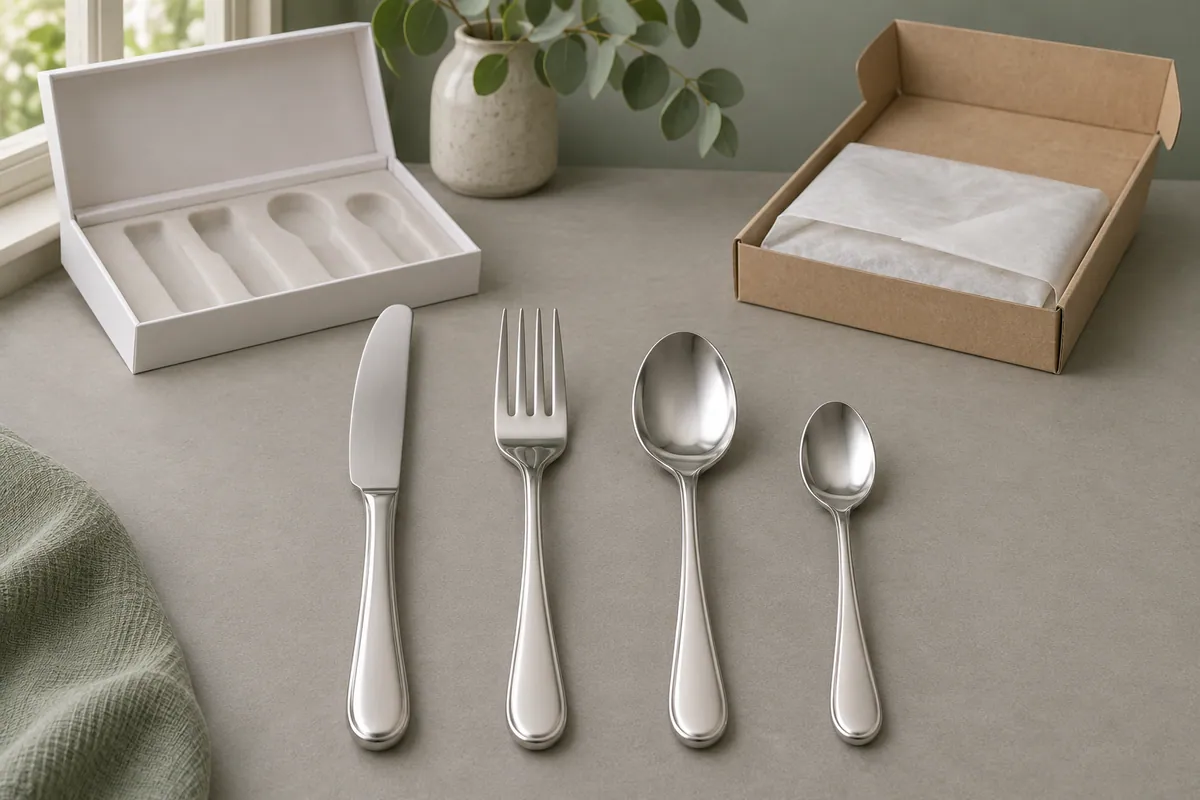
For a UK cutlery launch, specify what each person receives, what the customer sees before buying, and how the set survives delivery and return. A 30-piece set can add cake forks or soup spoons. Those are different assortments, even when both serve six people. A shelf-ready presentation box also needs a separate assessment before it becomes a parcel pack.
This study addresses large supermarket buying teams and e-commerce sales companies. Research date: 8 November 2026, Asia/Shanghai. It uses official statistics, legislation and 12 public product offers from two substantial retail chains, IKEA UK and Argos, and their respective webshops. These are two overlapping physical/online businesses, not four independent companies or a representative national grocery/marketplace panel. No store visit, purchase, consumer survey or laboratory test was conducted. Prices are displayed consumer prices in GBP, excluding delivery; trade values are current USD. The cover is an AI-generated editorial illustration, not a specific SKU, factory photograph or test record.
1. Demand context: an established online channel, with uneven monthly demand
The ONS September 2026 bulletin reports Great Britain retail volumes up 0.7% in the third quarter versus the second, but down 0.4% in September versus August. Online spending values fell 0.1% quarter on quarter, while increasing 7.4% against the third quarter of 2025. Online sales represented 28.8% of September retail spending in the seasonally adjusted series. These are broad retail indicators: Great Britain excludes Northern Ireland, and spending values are different from sales volumes. They do not measure stainless cutlery demand. ONS, released 23 October 2026.
For buying decisions, this supports preparing store and online presentations together while setting separate reorder rules. It does not justify scaling a flatware order by the national growth rate. A supermarket needs store-level sell-through, shelf space and replenishment evidence. An online operator needs conversion, delivery cost and net revenue after returns. None of those category-specific figures is supplied by this national bulletin.
2. Three years of imports: separate the product basket from stainless-only demand
UN Comtrade was queried for UK reporter 826, imports, World and selected partners, HS2022/H6, calendar years 2023–2025. HS8215 includes spoons, forks and related kitchen/table articles, including sets; HS821191 concerns fixed-blade table knives. They are not stainless-steel-only categories, nor retail sales. HMRC defines import valuation as CIF to the UK border, excluding UK duty and tax. Its methodology also records the 2022 break when GB imports from the EU switched to customs declarations while Northern Ireland–EU movements retained Intrastat. The three years below are all after that break. HMRC methodology.
| Year | HS8215, USD million | China share of HS8215 value | HS821191, USD million | HS8215 net weight, kg |
|---|---|---|---|---|
| 2023 | 78.510 | 72.50% | 11.766 | Not reported |
| 2024 | 78.001 | 73.51% | 10.255 | 13,539,252.836* |
| 2025 | 77.971 | 69.32% | 10.347 | 12,221,276.665* |
Sources: 2023 query, 2024 query, 2025 query. *The API flags these weights as estimated. The 2023 missing weight is not zero. All returned rows are marked as aggregates rather than directly reported rows; quantity fields without a valid unit are not piece counts. The 2025 response contains no Netherlands–HS821191 row: no zero was invented for it.
HS8215 value stays close to USD78 million across the three years. Within this basket, China’s value share falls from 73.51% to 69.32% between 2024 and 2025; Vietnam’s rises from 9.48% to 10.39%. This is a sourcing-diversification signal worth investigating, not evidence of a consumer preference or a supplier’s available capacity. Estimated weights, mixed articles and absent unit counts prevent a defensible calculation of a typical stainless set’s import price. Imports also do not reveal domestic output, inventory changes or onward distribution.
The current UK tariff API distinguishes, for example, 8215201000 for stainless articles within the relevant assorted-set branch and 8215991000 within the other-article branch. The knife heading includes 8211910000. Actual classification must follow the complete set, materials and applicable notes; the statistical headings are not shipment declarations. UK tariff heading 8215, heading 8211.
3. Twelve local offers: count utensil types before comparing prices
Both chains have physical networks and online ordering: IKEA stores, Argos stores. Observations below are public online offers, not verified stock at a particular branch or postcode. IKEA pages were captured directly; Argos pages were read through the web retrieval service after direct requests returned access-denied responses. Packaging dimensions and weights are retailer-listed, not our measurements. All alloy and dishwasher claims remain retailer claims, without independent component-level verification.
In the table, A means knife, fork, main spoon and teaspoon in equal quantities. B adds cake forks to A; C instead adds soup spoons. Argos uses “dessert spoon” for some main spoons; its Curve narrative and bullet list use different names for that spoon. D contains seven types: table knife/fork/spoon, teaspoon and dessert/salad knife/fork/spoon. Dimensions are width × height × length, in cm.
| Channel / product and SKU | GBP / pieces / settings | Composition | Material claim | Listed package cm / kg |
|---|---|---|---|---|
| IKEA MOPSIG 00343003 | 4.00 / 16 / 4 | A, 4 each | Stainless; grade unstated | 5 × 4 × 21 / 0.50 |
| IKEA FÖRNUFT 70014999 | 10.00 / 24 / 6 | A, 6 each | Stainless; grade unstated | 13 × 4 × 23 / 0.95 |
| IKEA MARTORP 30167507 | 29.00 / 30 / 6 | B, 6 each | Stainless; grade unstated | 25 × 5 × 34 / 1.50 |
| IKEA DRAGON 90091760 | 15.00 / 24 / 6 | A, 6 each | Stainless; grade unstated | 15 × 6 × 23 / 1.30 |
| IKEA SEDLIG 40155311 | 39.00 / 24 / 6 | A, 6 each | Stainless; grade unstated | 16 × 7 × 26 / 1.45 |
| IKEA 365+ 90399750 | 39.00 / 56 / 8 | D, 8 each | Stainless; grade unstated | 26 × 6 × 29 / 2.91 |
| Argos Habitat Curve 8372228 | 38.00 / 30 / 6* | C, 6 each | 18/10 | Not stated |
| Argos Home Square 6193454 | 16.00 / 16 / 4 | A, 4 each | 18/0 | Not stated |
| Argos Habitat Simplicity 9311776 | 39.00 / 32 / 8 | A, 8 each | 18/10 | Not stated |
| Argos Habitat Hammered 9311130 | 32.00 / 16 / 4 | A, 4 each | 18/10; hammered handles | Not stated |
| Argos Home Black 8241555 | 9.00 / 16 / 4 | A, 4 each | 18/0; black handle substrate unverified | Not stated |
| Argos Home Teaspoons 8523699 | 3.50 / 12 / — | Teaspoons only | 18/0 | Not stated |
*Curve’s narrative says six people and lists six of every utensil, while a bullet incorrectly labels the set as five place settings. Six is the count supported by the itemised contents; the inconsistency and spoon terminology should be resolved before reusing its listing as a specification. Argos does not establish separate blade grades in these observations. Missing packaging dimensions/materials remain missing, rather than inferred from photographs.
DRAGON’s GBP15 is the online price. Its page separately advertises GBP10 in store only, 1 September–20 December, while stocks last; this is not a universal online price. IKEA 365+‘s GBP39 is the displayed new lower price, with GBP45 shown as the previous price. No price is a binding wholesale quotation or guarantee of future availability.
4. What the assortment suggests about shelf and parcel packs
Among complete 16-piece sets, observed prices range from GBP4 to GBP32. The difference cannot be attributed solely to steel grade: the sample also varies in brand, finish, shape and construction. At GBP39, both a 32-piece Simplicity set and a 56-piece IKEA 365+ set serve eight; both cost GBP4.875 per setting before delivery, but offer four versus seven utensil types. The latter has a listed package mass of 2.91 kg; no comparable Argos package mass was obtained. A per-piece discount alone therefore cannot establish the better parcel economics.
These are proposed buyer tests derived from the sample, not measured preferences or proven packaging performance:
| Buying decision | Shelf-pack test | Parcel and return test |
|---|---|---|
| Entry complete set | Test a clearly labelled 16-piece / 4-person pack against the store’s price ladder | Show all 4 utensil types and quantities before checkout; test restraint against metal-on-metal movement |
| Expanded dinner set | Separate 30-piece cake-fork and soup-spoon versions; do not use one ambiguous carton description | Match the photographed contents, item list and picking record; count every compartment when returned |
| Replacement purchase | Trial a 12-teaspoon refill separately from full settings | Check whether delivery/handling leaves a viable contribution; do not promise profitability from GBP3.50 retail alone |
Ask for the closed retail-pack dimensions, packed parcel dimensions and gross weights as different fields. For store replenishment, request barcode position, shelf orientation, units per inner/master carton and replenishment lead time. For online supply, request a sample packed for the intended carrier and a documented transport-test plan. Neither a retailer’s package weight nor this article proves that a proposed export carton passes a test.
5. Returns and product information belong in the buying specification
For qualifying online consumer purchases, UK guidance allows customers to notify cancellation within 14 days of receipt, followed by 14 days to return. Standard outbound delivery is refundable under the applicable rules; premium delivery upgrades are treated differently. In-store change-of-mind purchases do not carry the same automatic right. Faulty or misdescribed goods are a separate issue. These are consumer-sale rules, not a default cancellation right in the importer’s B2B supply contract. Do not classify all opened cutlery as a hygiene exception. Government returns guidance, Consumer Contracts Regulations 2013, Part 3.
A practical procurement response is to agree a component count sheet, distinguish scratches present on arrival from damage discovered later, and retain batch identification through repacking. Obtain an accurate photograph of the delivered finish and handle, plus plain-language care instructions supported by the supplier’s evidence. Set contractual responsibility for missing pieces and replacement components. These steps make complaints easier to investigate; the research does not establish a national cutlery return rate or quantify a reduction.
Consumer prices in the sample cannot determine a target factory price. Prepare a contribution model using the actual selling price net of applicable tax, landed cost, fulfilment, platform/payment fees, expected refunds and recoverable returned-stock value. Keep unknown inputs blank until quotations and pilot sales exist. A low retail ticket may suit a store add-on while being uneconomic as a standalone parcel; that remains a hypothesis to test.
6. Imports, food contact and labels: split GB and Northern Ireland
The government’s import process separates Great Britain and Northern Ireland. Confirm the importer, required GB EORI or relevant XI arrangements, declaration route, origin, valuation and exact commodity code before ordering. A single duty rate cannot be assigned to every mixed cutlery set from the broad HS8215 heading. This study does not calculate a landed tax rate or certify a supplier. UK import process.
For Great Britain, the applicable food-contact framework includes assimilated Regulation 1935/2004: Article 3 addresses harmful transfer and unacceptable effects on food; Article 15 covers information and identification, with an obvious-food-use exception to the specific food-contact indication; Article 17 addresses traceability. Necessary instructions must follow the applicable language rules. The cup-and-fork symbol is not a test certificate. Good manufacturing practice under Regulation 2023/2006 requires quality systems and documentation. An “18/10” listing does not prove migration performance, knife-blade composition or coating suitability. Article 3, Article 15, Article 17, GMP regulation.
The GB general product-safety baseline and the EU regime applicable in Northern Ireland also differ. GB guidance retains the General Product Safety Regulations 2005; NI moved to EU Regulation 2023/988 on 13 December 2024. Apply the relevant safety, identification and supply-chain obligations alongside the food-contact rules, respecting their scope. Prepare a territory-specific document and label review instead of copying a GB label into every NI listing. GB guidance, NI guidance.
A timely development is the FSA’s 5 November 2026 NI consultation on consolidating domestic food-contact enforcement into proposed 2027 regulations. It is a consultation, not an enacted 2027 rule and not evidence that cutlery suddenly requires a new certificate. Monitor the final text if supplying NI. FSA consultation.
7. A table knife needs a sales-and-delivery assessment of its own
Do not infer a legal exemption from the word “cutlery”, a rounded photograph or a marketplace category. In England and Wales, the current Criminal Justice Act provisions cover under-18 sales and set minimum conditions for the due-diligence defence in remote sales, including age-checking, package identification, adult handover and no locker delivery where applicable. Scotland has distinct rules. Assess the actual knife and destination, rather than treating one checkout configuration as UK-wide. Section 141A, section 141B, government overview.
The Crime and Policing Act 2026 contains further remote-sale/delivery and bulk-reporting provisions. The legislation checked on 8 November marks the relevant groups as prospective, and section 255 provides for commencement by the relevant authorities. They must not be presented as all already operational merely because the Act exists. Its bulk-reporting definition excludes certain non-sharp-pointed eating knives; that limited exception is not a blanket exemption from existing age-sale rules. Recheck commencement and the applicable provision before launch. Act, Part 2 Chapter 2, commencement, section 255.
The sampled Argos pages label the knife-containing sets as 18+. Its teaspoon-only page also displays an 18+ notice. That is an observed listing detail, not proof that teaspoons legally require age verification. Separate retailer policy and possible template errors from statutory requirements when preparing product data.
8. Separate procurement actions for the two audiences
| Buyer | Evidence-led starting proposal | Information required before a purchase order |
|---|---|---|
| Large supermarket | Test an entry 16-piece set, a clearly differentiated dinner set and a replacement line; observed offers demonstrate these formats exist | Store price ladder, verified per-type counts, shelf-pack drawing, traceability information, case quantities and store-level pilot results |
| E-commerce sales company | Start with unambiguous contents and finish photographs; evaluate complete sets and refill orders separately | Actual parcel size/weight, carrier eligibility for knives, territory-specific checkout requirements, return inspection procedure and net contribution model |
| Both channels | Reuse approved product specifications, but validate each selling and delivery format | Material evidence for each component, intended-use testing scope, importer and destination, final artwork, packaging responsibilities and dated price/stock checks |
The evidence supports a controlled assortment trial, not a UK sales forecast. Close the outstanding SKU-level questions—blade classification, component materials, black-handle construction, Argos package dimensions, delivery charges, supplier testing and commercial terms—before setting quantities. Ask a supplier such as Yumingxing for those documents and comparable packed samples; capability, test performance and quotations remain to be demonstrated for the actual order.