
Turkey flatware procurement: benchmark local sets, packaging and import controls
· Yumingxing
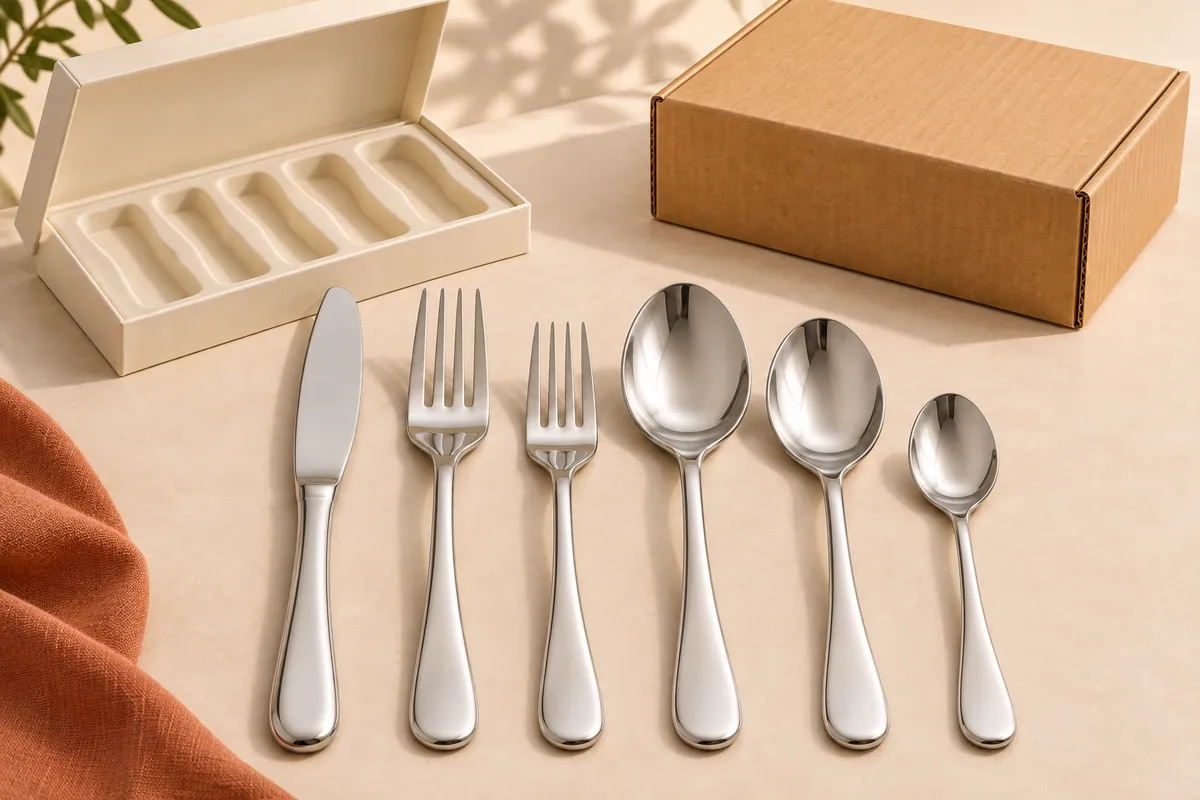
Research checked on 11 November 2026. Country study 21 of 30, for large supermarket buyers and e-commerce sales companies. The cover is an AI-generated editorial illustration, not a factory photograph or a pictured SKU.
Turkey already has visible branded flatware offers across small household sets and large presentation boxes. An importer needs a specific reason to earn shelf or search space: a clearer set composition, reliable material documentation, practical packaging or an economically justified replenishment offer. A low factory price alone does not establish that opportunity. This desk study compares twelve public offers with three years of imports and official channel and regulatory evidence.
1. Read imports as a competitive signal
| Year | HS8215 World, USD million | China value / share | HS821191 World, USD million | China value / share |
|---|---|---|---|---|
| 2023 | 35.995 | 29.164 / 81.0% | 6.069 | 2.977 / 49.0% |
| 2024 | 39.604 | 29.303 / 74.0% | 3.799 | 1.777 / 46.8% |
| 2025 | 36.366 | 27.512 / 75.7% | 4.586 | 1.931 / 42.1% |
Values are current US dollars, rounded to three decimals in millions; shares are calculated within each heading, not across the whole table. Sources: UN Comtrade, Turkey reporter 792, imports, world and China partners, HS2022 classification H6, annual 2023, 2024 and 2025, retrieved on the research date. The API returns twelve aggregate records, with primary values equal to CIF values. Aggregate flags are not evidence of missing trade. Zero supplementary-quantity fields are not zero imports; the underlying records retain net weights separately.
HS8215 covers several base-metal table and kitchen utensils and sets; it cannot isolate stainless steel or domestic retail consumption. HS821191 covers fixed-blade table knives, but it does not turn these two headings into an exhaustive flatware market. Mixed retail sets require their own classification. These are imports, with no subtraction for exports and no estimate of Turkish production or retail margins. National methodology uses CIF for imports; an independent Turkish customs extraction of these exact twelve cells remains a cross-check to obtain. TurkStat national metadata hosted by Eurostat
HS8215 value declined 8.2% in 2025 from 2024, while recorded net weight rose from 3,574,004 to 3,742,942 kg, or 4.7%. The corresponding average value per kilogram fell about 12.3%. This is a composition-sensitive customs ratio, not an identical-product price index or a supplier quotation. China represented 75.7% of 2025 HS8215 import value, against 42.1% for HS821191. The two patterns support separate costing of knives and other utensils; they do not prove a shortage that a new importer can fill.
2. A large online channel does not guarantee flatware growth
The Ministry of Trade reports 2025 general e-commerce volume of TRY4.567 trillion, up 52.2%, and retail e-commerce of TRY2.457 trillion, up 51.8%. These are nominal lira values, not physical unit growth. The general figure includes activities beyond retail, and neither is a flatware sales figure. Ministry release; 2025 e-commerce report, printed pages 18–19
For a supermarket buyer, this makes current online offers a useful comparator when negotiating a shelf assortment. For an e-commerce seller, it makes a separate delivered-margin calculation essential. Neither buyer should apply the national growth rate to a flatware forecast. Keep expected units, selling price, promotional discount and fulfilment cost as separate assumptions.
The sample covers two established physical retail chains, Karaca and Schafer, and two online sales channels: their own Turkish webshops. These are two overlapping organizations, not four independent chains. Karaca publishes a store directory; Schafer has a store locator, corroborated by an Axess participating-store address list. This is desk research of online offers associated with physical chains, not an in-store price survey. It does not measure nationwide channel shares or prove each SKU’s country of manufacture.
3. Twelve offers: compare the contents before the price
The following are observed public prices in TRY on 11 November 2026. Schafer explicitly labels its displayed prices VAT-inclusive; Karaca’s consumer offer values are recorded as displayed, with tax breakdown unverified. Checkout, local stock and shipping were not tested. Promotions can expire, and no price here is a wholesale quotation. All material descriptions are retailer claims, not laboratory findings.
| Channel / product | TRY observed price | Pieces / contents | Material claim / retail packaging |
|---|---|---|---|
| Karaca Emsan Akasya | 2999 | 72; 12 each dinner knife/fork/spoon, dessert fork/spoon, teaspoon | 18/10 stainless steel retailer claim; Boxed, title claim |
| Karaca Emsan Flow Platin | 2999 | 60; 12 each dinner knife/fork/spoon, dessert fork/spoon | 18/10 stainless steel retailer claim; Boxed, title claim |
| Karaca Emsan Ladin | 3999 | 84; 12 each dinner knife/fork/spoon, dessert knife/fork/spoon, teaspoon | 18/10 stainless steel retailer claim; Boxed, title claim |
| Karaca Emsan Sedir Elegance | 3794 | 84; 12 each dinner knife/fork/spoon, dessert knife/fork/spoon, teaspoon | 18/10 stainless steel retailer claim;304 also claimed; Boxed, title claim |
| Karaca Apricot Faro silver | 959.99 | 24; Dinner knife/fork/spoon, dessert fork; per-type counts unconfirmed | 18/10 stainless steel retailer claim; Boxed, title claim |
| Karaca Apricot Faro Matte Gold | 1299 | 24; 6 each dinner knife/fork/spoon, dessert fork | 18/10 stainless steel retailer claim; Boxed, title claim |
| Karaca Karaca Milas Platin | 1899 | 30; 6 each dinner knife/fork/spoon, dessert fork, teaspoon | 18/10 stainless steel retailer claim; Boxed, title claim |
| Karaca Emsan Boreas Platin | 3999 | 84; 12 each dinner knife/fork/spoon, dessert knife/fork/spoon, teaspoon | 18/10 stainless steel retailer claim; Undisclosed |
| Karaca Emsan Yakamoz | 2999 | 60; 12 each dinner knife/fork/spoon, dessert fork/spoon | 18/10 stainless steel retailer claim; Boxed, title claim |
| Schafer Sheen GUM20 | 1299 | 24; 6 each dinner knife/fork/spoon, dessert spoon | Stainless steel; simultaneous 304 and18/0 claims, unresolved; Undisclosed |
| Schafer Sheen GUM22 | 1299 | 24; 6 each dinner knife/fork/spoon, dessert spoon | Stainless steel; simultaneous 304 and18/0 claims, unresolved; Undisclosed |
| Schafer Lena | 1599 | 18; 6 each dinner knife/fork/spoon | 304 /18/10 stainless steel retailer claim; Undisclosed |
Karaca’s nine sampled pages showed in-stock structured offers and a dispatch estimate of 16–18 November; that is not a delivery promise for a specific address. Several pages showed member-only free-shipping messaging. Schafer’s three pages showed low-stock messaging; Lena displayed free shipping, while a site banner used a TRY1500 threshold. Confirm final eligibility at checkout. Retail-box dimensions, gross weights and export-carton specifications were not disclosed in the sampled product descriptions.
Three distinctions matter for an import brief. First, Faro’s 24-piece configurations include dessert forks, whereas Sheen’s 24 pieces include dessert spoons. A picture of four utensil types is insufficient to make those sets equivalent. Second, Milas adds a fifth type at 30 pieces, while the 60-, 72- and 84-piece offers distribute different numbers of utensil types across twelve people. A larger count is not automatically a better price per place setting. Third, the two Sheen variants simultaneously use “304” and “18/0” in their material copy. Record the ambiguity and request composition evidence; do not silently correct it or reuse it as a verified grade.
At the observed prices, Faro silver and matte gold differ by TRY339.01, or 35.3%, for the same stated piece count. Their care instructions also differ: the silver listing permits dishwasher use, while gold recommends hand washing. This pair supports testing whether a buyer will pay for a particular finish and accept its care requirements. It does not establish the cost of coating or a national willingness to pay. The two Sheen variants are separate SKUs within one series, so the twelve observations are not twelve independent product concepts.
4. Confirm the import route and the finished article
The 2026/5 import-control text lists heading 82.15 and fixed-blade table knives 8211.91.00.00.00 in Annex2. Articles4,5 and12 address prior notification, the Ministry’s conformity letter and customs presentation. Its temporary provision deferred selected added headings until 1 March 2026; the parenthetical exception for 8215.20.10.00.00 concerns that deferral, not a blanket exemption from control. Official ministry copy
The Ministry’s operating guidance describes GGBS registration, product notification and shipment notification. Before quoting a delivered order, have the Turkish importer identify the complete GTIP, current inspection procedure, documents, customs charges and responsible port. A food-contact conformity letter is not interchangeable with an ordinary supplier’s material statement. This study does not establish a duty rate, a CE requirement or clearance of any actual SKU.
The April 2026/34 amendment changes specified chemical, seed, spice and algae entries; the July 2026/42 amendment changes specified plastic-related entries. Neither text changes the cited82.15 or8211.91 entries. This is a comparison of those two amendments, not a guarantee about every future consignment. April original text, KPMG-hosted copy; official April issue; July official text
The food-contact regulation requires good manufacturing practice and protection against harmful migration or unacceptable food changes; misleading claims are prohibited. Article13 covers identification, use instructions and traceability information, with Turkish required for specified consumer information. The food-contact symbol/wording has an exception where intended food use is obvious. Articles14–15 address conformity documentation and traceability. Original regulation, Articles5 and13–15
Annex4 expressly distinguishes stainless steel from other metals in its coating provision. That does not make every stainless product compliant or excuse assessment of a coloured finish. Establish the substrate, coating system, intended use and matching test evidence for the finished article. The 2019 amendment concerns the aluminium provision; it is not a new flatware approval. Ministry consolidated text, Annex4; 2019 amendment
5. Two purchasing briefs with different acceptance tests
| Decision | Large supermarket buyer | E-commerce sales company |
|---|---|---|
| Opening assortment | Test a clearly specified 24- or 30-piece everyday set against the smaller sampled offers; add a large boxed set only with a defined shelf role | Start with one exact piece map; test a finish or larger configuration only after its own margin and return review |
| Presentation | Show utensil types and counts on the retail box; measure shelf frontage and stacked-box strength | Show a full contents image, individual dimensions, actual finish and care instructions; separate variants accurately |
| Packaging | Obtain unit-box dimensions, barcode position, inner/master-carton count and replenishment unit | Obtain parcel dimensions/weight, abrasion protection and a drop-test proposal for the actual packed set |
| Material evidence | Match composition documents, coating information and batch identification to the approved sample | Use only substantiated material and care claims in the listing; retain a link from orders to batches |
| Reorder condition | Review sell-through, shelf damage and missing-piece claims before adding stores | Review delivered contribution, returns and fulfilment defects before buying more traffic |
These are proposed tests inferred from the observed assortment, not measured consumer preferences. For the supermarket, define a comparison basket by utensil type and material evidence before requesting quotes. Compare a Turkish stockholding offer with an imported offer on the same delivered and replenishment basis; the research does not contain either wholesale quotation. Ask how quickly a missing component can be replaced without writing off an entire presentation box.
For e-commerce, calculate contribution per delivered order as revenue after applicable tax less landed goods cost, channel/payment fees, fulfilment, shipping, advertising and expected return/replacement expense. Use quotations and your own operating records for every input. The public TRY959.99 or TRY1299 anchors are selling-price observations, not permissible factory-cost ceilings. A low unit cost can be offset by a large parcel, finish-related returns or incomplete sets.
6. What would make the import opportunity testable?
Request a twelve-month procurement proposal with a shorter initial release, rather than inferring an order volume from national statistics. Specify the exact utensil map; material by component; finish and care; Turkish label draft; compliance documents; boxed and parcel dimensions; minimum order and reorder quantities; lead time; replacement components; and Incoterm. Require the supplier to distinguish existing evidence from tests still to be commissioned.
The present evidence supports a comparison exercise against branded local retail offers. It does not establish that Turkish production is expensive, that a particular imported design will sell, or that a retailer is seeking a new supplier. Remaining commercial gaps include wholesale prices, delivered duties, audited origin, actual package measurements, checkout costs and customer-return data. Resolve those with the intended importer and buyer before committing stock. For a structured brief, use our contact page; nothing in this study asserts factory testing, customer orders or SKU certification.