
Thailand flatware procurement: compare pairs, finishes and channel packaging
· Yumingxing
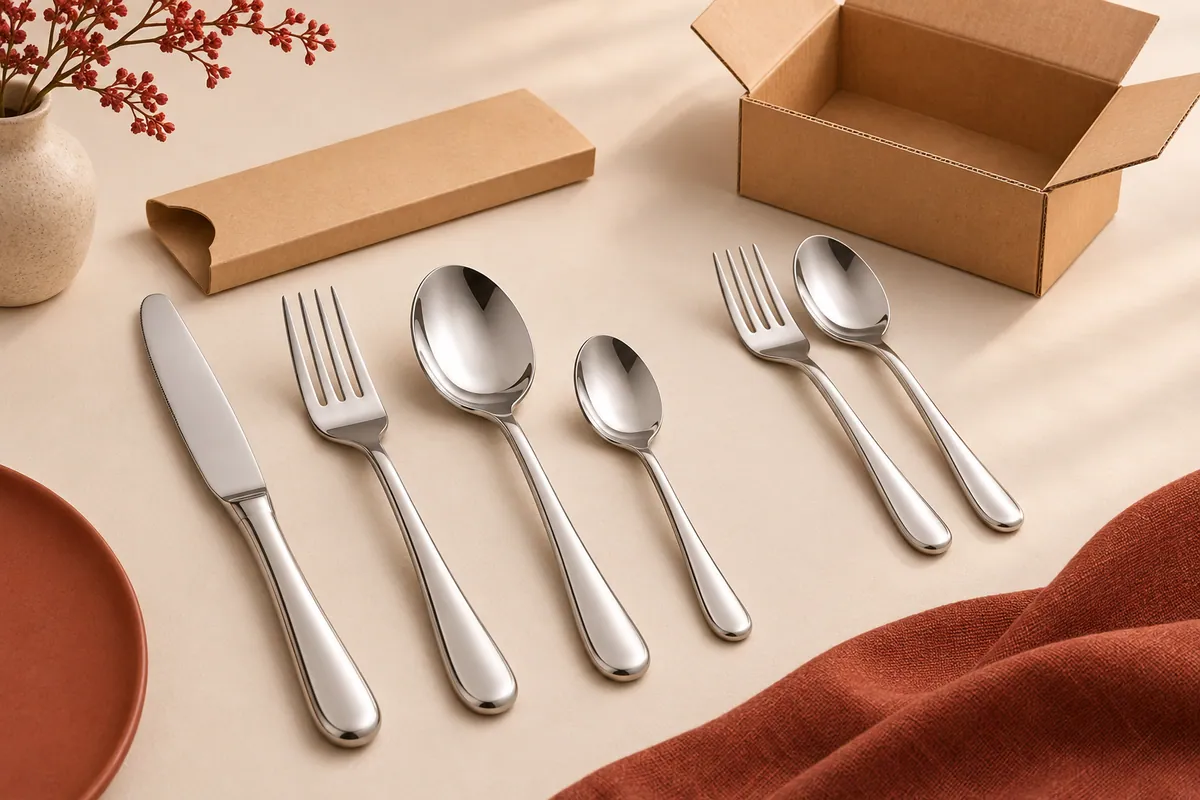
Thailand’s observed assortment suggests starting procurement with spoon-fork pairs and explicit pack contents, then deciding whether finish or presentation earns an additional price. Two comparable KECH six-piece offers were both THB179: the gold version did not command a higher displayed price than silver. That is evidence against assuming an automatic colour premium, not proof that finishes never affect demand.
This is public-source desk research for large supermarket buying teams and e-commerce sales companies, initially collected on 7 November 2026 and reviewed on 10 November 2026, Asia/Shanghai. It includes no store visits, purchases, consumer interviews or laboratory tests. Prices are Thai baht (THB); trade values are current USD. The cover is an AI-generated editorial illustration, not a real SKU, factory photograph or compliance record.
Regulatory snapshot: on 10 November, TISI’s own standard record classifies TIS 3206-2567 as a general standard. Its start date and a proposed compulsory-rule timetable are different facts, explained in section 6. This research is not a shipment-specific clearance decision.
1. Channel context: separate retail activity from e-commerce turnover
The Bank of Thailand’s retail index, base 2019=100, was updated on 4 November 2026. Its latest displayed month, August 2026, is estimated: the overall index is 161.71, the department-store/supermarket/general-store category 169.40, and mail-order/Internet retail 1,573.18. These measure changes relative to each category’s own base, not category shares. Dividing the Internet index by the overall index would not produce online penetration. BOT EC_EI_032_S3.
ETDA’s downloadable industry table excludes government e-Auction. It reports total e-commerce value of THB4.866 trillion in 2022 and THB5.189 trillion in 2023, with THB5.513 trillion for 2024 explicitly forecast. The retail-and-wholesale category is respectively THB2.832 trillion, THB3.029 trillion and THB3.235 trillion forecast. These are not B2C-only retail totals and do not isolate flatware. Do not relabel the forecast as an actual result or combine it with a different table including government procurement. ETDA dataset, original CSV.
For a buyer, these sources justify examining both shelf and online execution. They do not determine how many flatware sets a specific retailer can sell. Use the retailer’s own sell-through, conversion, returns and replenishment records to size a trial.
2. Three years of imports: a sourcing signal, not the stainless-steel market size
The table uses Thailand-reporter imports from UN Comtrade, HS2022/H6, partner World, calendar years 2023–2025, CIF/current USD. HS8215 covers specified base-metal spoons, forks and kitchen/table articles, including designated sets and precious-metal-plated subheadings; HS821191 covers fixed-blade table knives. Neither series isolates stainless steel or measures retail sales. WCO HS2022 Chapter82.
| Year | HS8215, USD million | China share of HS8215 value | HS821191, USD million | HS8215 net weight, kg | Table-knife quantity, items |
|---|---|---|---|---|---|
| 2023 | 12.124 | 87.60% | 0.757 | 4,973,858.453 | 2,926,507 |
| 2024 | 11.635 | 86.93% | 0.701 | 4,884,671.872 | 2,285,713 |
| 2025 | 10.724 | 86.83% | 0.696 | 3,773,369.032 | 1,470,880 |
Sources: 2023 API, 2024 API, 2025 API. Rounded values and shares are our calculations. Net weights are flagged as estimated; knife item quantities are not flagged as estimated. All selected records are aggregates (isAggregate=true, isReported=false), not shipment observations. World and China are selected partners, not a full supplier ranking.
HS8215 value declined across these years. That does not establish falling stainless-steel consumption: the category mixes articles and materials, and trade is distinct from domestic production, inventory movements and retail margins. It does support challenging a supplier’s unsupported “fast-growing market” assertion and avoiding a volume commitment based only on a national headline.
3. Twelve public offers: keep pairs, pieces and packaging separate
The sample covers HomePro and Big C, two physical retail chains, and their own webshops as the two online channels. These are overlapping organisations, not four independent channels; no marketplace share or in-store price equivalence is claimed. HomePro pages were directly retrieved again on 10 November, with unchanged prices. Big C’s direct collection returned 403; its full public pages were reread through the web retrieval service on 10 November, with unchanged prices and a crawl age of three days. These are dated observations, not guaranteed live checkout prices. Availability means a displayed offer/Add-to-cart indication, not a completed postcode-specific checkout.
| Retailer / SKU | Displayed THB | Contents used for comparison | Material/finish stated by retailer | Packaging evidence |
|---|---|---|---|---|
| HomePro KECH CORA 1309852 | 399 | 6 spoons + 6 forks, 12 pieces | 430 stainless steel | Retail-pack construction not established |
| HomePro KECH 1269295 | 179 | 3 spoons + 3 forks, 6 pieces | 410, gold, claimed 3 mm | Not established |
| HomePro KECH 1269287 | 179 | 3 spoons + 3 forks, 6 pieces | 410, silver, claimed 3 mm | Not established |
| HomePro SEAGULL 1114808 | 200 | 12 spoons + 12 forks, 24 pieces | Stainless steel; grade unspecified | Not established |
| HomePro ROCKET 1129784 | 159 | 12 spoon-fork pairs, 24 pieces | Stainless steel; grade unspecified | Not established |
| HomePro COLOR KIT 1012848 | 149 | 12 spoon-fork pairs, 24 pieces | Claimed 11–16% chromium, 0.8 mm | Not established |
| HomePro SEAGULL 1114933 | 330 | 6 spoon-fork pairs, 12 pieces | Stainless steel; grade unspecified | Not established |
| Big C BESICO 63482 | 239 | 12 pieces; exact split unstated | Stainless steel; grade unspecified | Not established |
| Big C SEAGULL Curve 11887505 | 165 | 3 pairs, 6 pieces | Stainless steel, claimed 2 mm | Not established |
| Big C BESICO BS41248 / 11916893 | 49 | 2 fruit forks | Stainless steel; 5.5-inch length claim | Not established |
| Big C BESICO BS41250 / 11916898 | 129 | 6 pieces; exact split unstated | Stainless steel; 8-inch spoon/fork length claim | Not established |
| Big C SEAGULL Khao Thai 11887503 | 49 | Spoon/fork kit; count to confirm | Stainless steel; grade unspecified | Green plastic carrying case stated |
These are retail observations, not factory quotes, exclusive-of-tax benchmarks or verified material test results. Threshold coupons and conditional additional discounts are excluded. No sample establishes coating chemistry, coating life, master-carton quantity or shipping-test performance. Do not convert “gold” into “PVD” or a generic stainless description into 18/10.
Several rejected references illustrate the risk: a Zebra listing’s “pack 12” title describes 12 pairs in its detail; another discounted spoon offer stated a promotion ending 4 November 2026, before this research date. A coming-soon offer is not current stock. They are not used to set the current comparison range. HomePro ANCHOR 1221887 also had conflicting availability signals and was excluded from the twelve-offer table.
4. What the sample supports for supermarket buyers
Compare like-for-like pairs first. Within the observed 24-piece spoon-fork packs, THB149/159/200 corresponds to approximately THB12.42/13.25/16.67 per pair. The THB330 twelve-piece pack is THB55 per pair; the THB399 twelve-piece CORA set is THB66.50. These calculations help organise a shelf review, but they do not isolate a grade, brand or thickness premium because several attributes differ simultaneously.
Start a range review with three separate briefs: a replenishment-oriented spoon-fork multipack, a smaller presentation-oriented pair set, and a portable kit. This is an assortment hypothesis from the sample, not a national preference survey. Do not substitute a Western four-utensil place-setting count for a spoon-fork pair without checking the chain’s own sales history.
For each brief, ask suppliers for the unit bill of materials, piece count, pair count, utensil dimensions and mass, retail-pack photographs, barcode location, shelf dimensions and units per inner/master carton. The observed pages do not establish outer-pack dimensions; product dimensions are insufficient for freight or shelf-density calculations. Approve a physical packaged sample before assigning shelf space or ordering display-ready cartons.
5. What the sample supports for e-commerce sellers
Make the counting convention visible in the first image and title. A 12-pair set contains 24 utensils; a twelve-piece set does not necessarily provide twelve users. List each utensil type separately and state whether a case is included in the advertised total. Where the source leaves the split unspecified, obtain the supplier’s signed packing list rather than filling it from a photograph.
For finish tests, use a matched pair of listings: identical contents, dimensions, material declaration and fulfilment offer, with finish as the intentional difference. The KECH observations show gold and silver at the same THB179. A proposed premium therefore needs the seller’s own conversion and return evidence; it cannot be justified from this snapshot alone. Require coating-process information and care instructions before promising dishwasher durability or scratch resistance.
Keep two packaging specifications: the shopper-facing pack and the parcel-facing protection. The portable kit confirms a carrying-case proposition, but its case is not evidence of transit protection. Check rubbing between polished utensils, sharp-end restraint, count verification and parcel dimensions with packed samples. Track missing-piece, surface-damage and incorrect-count complaints separately so that a larger bundle does not hide an avoidable return cost.
6. Import, labelling and food-contact checks: dated evidence matters
Stainless-specific labels. OCPB Notification No.34, B.E.2555, explicitly covers stainless food containers/utensils and lists spoons, forks and knives. Its additional label provisions identify the stainless type by the cited Thai/international standard, with examples such as SST304/SST430; where the raw material falls outside those standards, the notice specifies composition information. It also prescribes use/care and warning information. A retailer’s unqualified “stainless” title is therefore not an adequate import-label specification. OCPB original, two scanned pages.
OCPB’s general label amendment No.3, B.E.2565, lists such matters as product identity, importer identity/address, manufacturing country, relevant quantity/dimensions, usage/care, warnings and date information. No.5, B.E.2567, changes transitional treatment for qualifying older labelled stock; do not apply that exception to a new import programme without checking its conditions. No.3 original, No.5 original.
The separate B.E.2569 controlled-category notice was published 17 September 2026 and states effectiveness after 90 days. It must not be treated as already effective on 10 November. Its scope and interaction with specific notices require a dated label review for the actual shipment. 2026 original, pages 1–3.
Food-contact standard: distinguish the standard from a compulsory regulation. TISI’s current standard record, retrieved on 10 November 2026, explicitly classifies TIS 3206-2567 as a general standard. It records 24 July 2024 as the standard’s start date, after Gazette publication on 23 July, replacing TIS3206-2564. Its scope covers stainless utensils directly contacting food/drinks, with stated exclusions including brazed cookware covered by TIS2440, storage/transport utensils and industrial/slaughterhouse equipment. A standard’s start date is not, by itself, the commencement date of a compulsory import requirement. TISI official standard record.
The separate 2025 draft notified as G/TBT/N/THA/671/Rev.2 proposes a compulsory rule with a 270-day interval after Gazette publication. Its annex includes spoons and forks; the document has an unsigned, undated ministerial signature block. The attached standard copy is marked for consultation. This is a proposal, not evidence that the 270-day clock has begun or that the draft is the final enacted text. Do not calculate a compulsory start date from the 2024 standard publication. Thai draft submitted to WTO, pages 1–3.
For buying decisions, specify food-contact safety evidence and the applicable material/label requirements now, while assigning the Thai importer responsibility to check the current compulsory list and any later Gazette instrument before shipment. Match the actual utensil and construction to its scope; do not assume every table knife, mixed-material handle or carrying case follows an identical route. TISI’s licensing/testing procedure is useful for planning an evidence dossier, but neither it nor a general-standard listing certifies the sampled products or gives a blanket permit exemption. TISI compulsory-standard register, TISI specific licensing/testing procedure.
Tariffs. Obtain the applicable Thai tariff line and import-date rate for each actual article, composition, origin and set presentation using Customs’ tariff services. An HS8215 trade aggregate is not an import-entry classification or a duty quote. This study does not establish an unconditional preferential rate, permit exemption or universal certificate route. Thai Customs tariff services.
7. A procurement brief that can be quoted consistently
| Decision | Supermarket buying team | E-commerce sales company |
|---|---|---|
| Selling unit | Explicit pair/piece count; shelf and inner-pack plan | Itemised contents; case counted separately; listing variant control |
| Material and finish | Grade evidence and approved retail label | Same evidence plus substantiated finish/care claims |
| Packaging | Actual retail-pack dimensions and display samples | Packed parcel size/mass and protection trial |
| Commercial comparison | Landed cost per approved selling unit | Landed cost plus fulfilment and measured return cost |
| Reorder trigger | Chain’s sell-through and inventory cover | Seller’s conversion, returns and stockout history |
| Release condition | Confirm current import, label and food-contact requirements | Same release condition; online copy must match the approved pack |
The useful output of this research is a more precise quotation and validation process. A supplier should quote the same approved selling unit, packaging and evidence scope for both channels; order depth and any finish premium remain decisions to test with the buyer’s own results.