
Saudi flatware procurement: match set contents, Arabic information and import evidence
· Yumingxing
For a Saudi flatware range, define the contents of a sellable set, the Arabic information and the responsible importer together. A low headline price cannot compensate for a missing knife, unclear coated-metal specification or a label that must be redesigned after production.
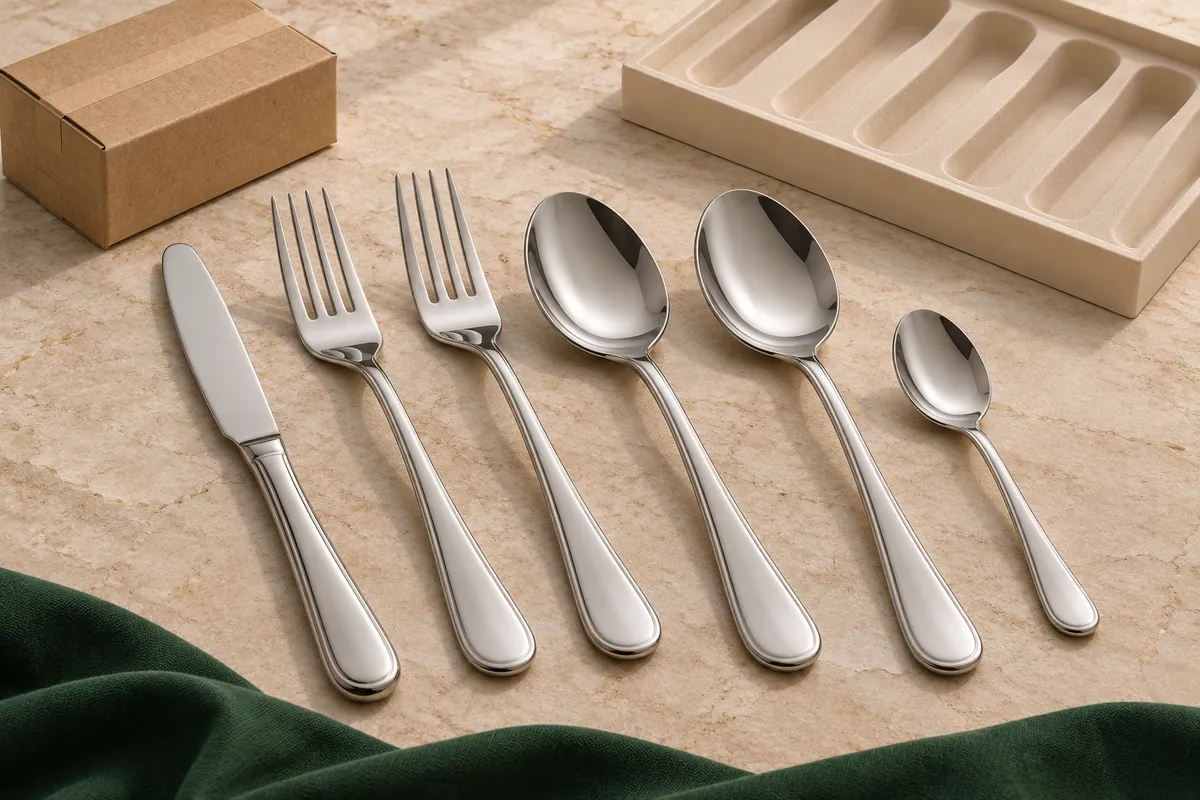
Market and price observations: 11 November 2026, Asia/Shanghai; regulatory scope and current SABER code mapping supplemented 21 November 2026. The supplement does not refresh the quoted retail prices. Twelve public product samples come from IKEA Saudi Arabia and Home Centre Saudi Arabia: two physical retail chains and their two overlapping own webshops, not four independent businesses. These homeware offers are benchmarks for supermarket and e-commerce buyers, not a survey of hypermarket shelves, marketplace sellers or national market shares. No physical visit, checkout, wholesale quotation or product test was performed. Physical-channel references: IKEA stores and Home Centre store locator. The cover is an AI-generated editorial illustration, not a factory photograph or a specific SKU.
1. Retail growth supports channel testing, not a flatware sales forecast
GASTAT’s Q2 2026 release reports retail operating revenue, excluding motor vehicles and motorcycles, up 5.2% year on year but down 0.9% quarter on quarter. Its e-commerce sales index for that same retail activity rose 13.4% year on year and 1.1% quarter on quarter. The release’s broader e-commerce index rose 9.8% year on year. These are different series: the broader figure must not replace the retail figure. GASTAT Q2 2026.
These indicators do not give flatware revenue, online penetration or unit demand. Dividing the two growth rates would not produce an online market share. They support testing an online assortment alongside store replenishment; they do not support assuming that every tableware line grows at the retail e-commerce rate. Obtain the buyer’s category sales, realised selling prices and returns before setting order volumes.
2. Three import years show different movements for utensils and table knives
UN Comtrade was queried for Saudi reporter 682, imports, World and China, 2023–2025, HS8215 and HS821191. All twelve returned rows use H6/HS2022; primary values equal CIF values in current USD. World totals are aggregates, not individual transactions. China is a selected origin comparison, not a ranking of all suppliers.
| Year | HS8215 World, USD million | China value / share | HS821191 World, USD million | China value / share |
|---|---|---|---|---|
| 2023 | 27.041 | 21.247 / 78.6% | 1.354 | 0.602 / 44.5% |
| 2024 | 29.607 | 24.599 / 83.1% | 1.052 | 0.583 / 55.5% |
| 2025 | 32.178 | 25.216 / 78.4% | 0.809 | 0.537 / 66.5% |
Original query results: 2023, 2024, 2025. GASTAT’s national methodology identifies customs administrative records as the import source and CIF as the import valuation basis. It does not independently confirm the detailed values above; those remain the cited Comtrade observations. GASTAT annual trade methodology.
HS8215 includes spoons, forks, ladles and related utensils of base metal; it is not a stainless-steel-only series. HS821191 covers fixed-blade table knives. Chapter 82 also has rules for mixed sets, so the headings must not simply be added and called a complete flatware market. Domestic production, re-exports, inventories and retail margins are outside this calculation. WCO Chapter 82.
The broad utensil value rises while the separately observed knife value falls. That is a reason to examine set composition, not evidence that Saudi consumers stopped using knives. China’s HS8215 value share remains high across the three observations; it says nothing about any factory’s share or achieved retail margin. Quantity fields are unsuitable for a price-per-piece comparison: the 2023 World HS8215 net weight is missing, several weights are estimated, and zero or unavailable supplementary quantities are not zero demand. Raw flags are retained in the research record.
3. Compare usable combinations before comparing prices
Prices below are Saudi-riyal public retail offers observed on the research date, excluding any unverified delivery charge or checkout adjustment. Reference prices are displayed comparisons, not guaranteed future prices. All material descriptions are retailer claims; no alloy grade or test certificate was independently obtained. IKEA package dimensions are retail packages, not export cartons. Home Centre shipping dimensions and packing weights were not disclosed.
| Channel / product | SAR observed price | Pieces / contents | Material / retail package W×H×L cm; kg |
|---|---|---|---|
| IKEA MARTORP | 149 | 30; 6 each knife/fork/spoon/teaspoon/cake fork | Stainless steel; 25×5×34; 1.5kg |
| IKEA SJUGÄLSHAJ | 99 | 24; 4 utensil types named; per-type counts unconfirmed | Stainless steel; 14×6×24; 1.15kg |
| IKEA TILLAGD brass-colour | 299 | 24; 6 each knife/fork/spoon/teaspoon | Stainless steel; metallized; 14×5×25; 1.47kg |
| IKEA FÖRNUFT | 59.95 | 24; 6 each knife/fork/spoon/teaspoon | Stainless steel; 13×4×23; 0.95kg |
| IKEA PRAKTBOTIA | 49.95 | 16; 4 utensil types named; per-type counts unconfirmed | Stainless steel; 14×6×24; 0.85kg |
| IKEA FÖRNUFT fork | 10.95 | 4; 4 forks;19cm | Stainless steel; 3×3×20; 0.15kg |
| IKEA DRAGON teaspoon | 15.95 | 4; 4 teaspoons;13cm | Stainless steel; 3×2×14; 0.09kg |
| IKEA FÖRNUFT knife | 10.95 | 4; 4 knives;21cm | Stainless steel; 2×2×21; 0.2kg |
| Home Centre Fiesta | 159 (reference 199) | 24; 6 each knife/fork/spoon/teaspoon | Stainless steel; Gold; coating chemistry unknown; Package undisclosed |
| Home Centre Laguna | 199 (reference 249) | 24; 6 each knife/fork/spoon/teaspoon | Stainless steel; Multicolour; coating chemistry unknown; Package undisclosed |
| Home Centre Essential | 39 | 12; 6 spoons +6 forks | Stainless steel; Silver colour; Package undisclosed |
| Home Centre Dinnerlite | 59 (reference 79) | 25; 6 each knife/fork/spoon/teaspoon +1 holder | Stainless steel; Black listing colour; not proof of metal coating; Package undisclosed |
The FÖRNUFT 24-piece offer is SAR9.99 per four-utensil place setting after rounding, whereas Essential is SAR6.50 per spoon-and-fork pair. These are different contents, not competing prices for the same product. Dinnerlite’s “25” counts 24 utensils plus one holder; at SAR59 it is approximately SAR9.83 per four-utensil place setting with a shared holder. That calculation does not assign the holder a separate value.
Fiesta at SAR159, Laguna at SAR199 and TILLAGD at SAR299 each specify six four-utensil settings: approximately SAR26.50, SAR33.17 and SAR49.83 per setting. This is a sampled price ladder, not proof that a colour treatment causes the whole premium. MARTORP adds cake forks; SJUGÄLSHAJ and PRAKTBOTIA name utensil types without a verified per-type count in the retrieved text. Confirm their bills of materials rather than filling the gap by division.
The pages also expose data-quality risks. Fiesta and Laguna list unusually short knife/fork dimensions that need physical confirmation; do not copy them into a purchasing specification. Dinnerlite’s holder dimensions are not its shipping dimensions. A separate IKEA 365+ 56-piece page displayed SAR229 but was marked out of stock in its offer data, so it is excluded from the twelve active-offer observations. No inference about sales velocity follows from that status.
4. Keep food-contact, importer and online-information checks distinct
SASO’s kitchen food-contact regulation, version 1/amendment 1, addresses foreseeable food contact, material composition, migration and conformity. Annex 2-a lists SASO ISO8442-2 for stainless-steel and silver-plated table cutlery. Articles 5–6 require Arabic or Arabic-and-English labelling, durable instructions, a recognised food-contact symbol, traceability and the applicable conformity file. For products within its scope, it specifies a notified-body Type 3 route. The Arabic original governs. Official English text; Arabic regulation and original download.
The Arabic customs annex directs readers to SABER for updated product/code mappings. The public SABER lookup retrieved on 21 November gives the following relevant branches. Each maps to the Technical Regulation for Food Safety in Tools and Appliances Used in the Kitchen, with a quality-mark certificate (QM) or product conformity certificate (COC) shown in the required-certificates column. These are observed portal requirements, not certificates held by the sampled retailers or our factory. SABER 8215 results; SABER 821191 results.
| Full code observed | Branch description / buyer’s classification check | Portal certificate alternatives |
|---|---|---|
| 821520000000 | Other assorted sets; verify the actual combination and plating | QM or COC |
| 821599000000 | Other articles within HS8215; verify the material and finish | QM or COC |
| 821191900000 | Other fixed-blade table knives; verify construction and handle | QM or COC |
The lookup also returns precious-metal-plated branches, so a brass-colour description must not be treated as proof of precious-metal plating. Ask the importer to record the final full code against the actual bill of materials and finish, then obtain the product-specific conformity decision. The lookup does not determine a customs-duty rate or prove shipment clearance. SASO product-tracking guidance.
For edition control, ISO’s catalogue identifies ISO 8442-2:1997 as current, confirmed in 2025. That international status does not establish the Saudi adoption year or the edition accepted for a particular conformity file. Before commissioning tests, have the importer and conformity body confirm the applicable Saudi edition through the official standards service; this review did not purchase or inspect its full text. ISO catalogue; SASO standards service.
The current Product Safety implementing regulation separately requires importer identification and postal/electronic contact information on the product, with an accompanying-document option when size or nature prevents marking, under Article 19. Article 32 requires Arabic online safety information; another language may accompany it. Article 35 requires online stores to assess and answer unsafe-product reports within 72 hours. SASO current implementing regulation.
The official bilingual SABER circular requires supplier-name/commercial-registration marking from 1 October 2026 for its ten listed technical regulations. We checked both pages: the kitchen food-contact regulation is not named in that list. This finding concerns that circular’s enumerated scope; it does not remove the general importer-identification duties or applicable kitchen-regulation labels described above. Keep those requirements in the artwork approval file. Official circular, Arabic p.1 and English p.2.
5. Turn the evidence into two buying programmes
For large supermarkets, start the assortment discussion with a clearly counted everyday four-utensil setting, a spoon/fork replenishment pack and a separately justified decorative option. This is our inference from observed formats, not a claim about Saudi household preferences. Use a shelf card showing exactly which utensils are included, the Arabic description and care information. Ask for the retail barcode, outer-carton count, shelf-facing dimensions and replacement-pack continuity. Validate decorative finishes and testing requirements separately instead of extending an uncoated sample’s documentation to them.
For e-commerce sellers, put the complete contents in the title or first specification block and show the holder separately from utensils. Explain replacement packs as four forks or four teaspoons; do not let a single-piece photograph imply a full setting. Require actual parcel dimensions and a packing trial for knife-tip protection and surface scuffing. A colour name is not a material specification, and “stainless steel” does not establish 304, 18/10 or coating chemistry.
Package size creates a measurable fulfilment question. The observed MARTORP retail box is 25×5×34cm = 4,250cm³, while FÖRNUFT’s is 13×4×23cm = 1,196cm³—about 3.55 times the volume. Their listed package weights are 1.50kg and 0.95kg. This does not yield a freight bill: an outer mailer, padding, carrier divisor and service area are still missing. Request a packed-parcel quote for each design before treating the retail price spread as a margin opportunity.
ZATCA’s import VAT guide describes a standard 15% rate, subject to applicable exceptions, on a base that includes the relevant customs value and charges. Recoverable input VAT and cash paid at import are different budgeting questions. No blanket customs-duty rate is assigned here: confirm the full code, origin and transaction. ZATCA import VAT guide.
Prepare the commercial invoice, transport documents and product-specific requirements with the importer. ZATCA’s import instructions mention 48 hours, while a separate official advance-declaration notice says 72 hours; this review does not reconcile that difference into one universal deadline. Confirm the current port/process rule before booking. Import instructions; advance-declaration notice.
6. Release the order only after the missing fields are closed
| Decision | Supermarket buying file | E-commerce buying file |
|---|---|---|
| Contents and price | Signed utensil counts; target shelf price and replenishment unit | Listing counts match packed contents; promotions separated from base price |
| Materials and evidence | Alloy/finish declaration and applicable product conformity evidence | Same SKU evidence; no unsupported grade, coating or safety claims |
| Arabic and traceability | Approved artwork, importer details and batch linkage | Arabic safety information, visible seller contact and complaint handling |
| Packaging | Retail pack, master-carton quantity/dimensions, shelf trial | Protected parcel dimensions/weight, packing trial and return handling |
| Economics | Import cost, store handling and actual category sell-through | Import cost, fulfilment, fees, returns and contribution per delivered order |
The commercial hypothesis is a limited range with explicitly different contents and a tested decorative tier. Confirm it with the buyer’s category data and an agreed sample order, not an invented national demand estimate. Neither sampled listings nor trade growth determines a first-order quantity, MOQ or lead time. Ask suppliers to quote against the approved specification; decide replenishment after reviewing actual sales, defects and delivery costs.