
Netherlands flatware procurement: separate local retail from redistribution
· Yumingxing
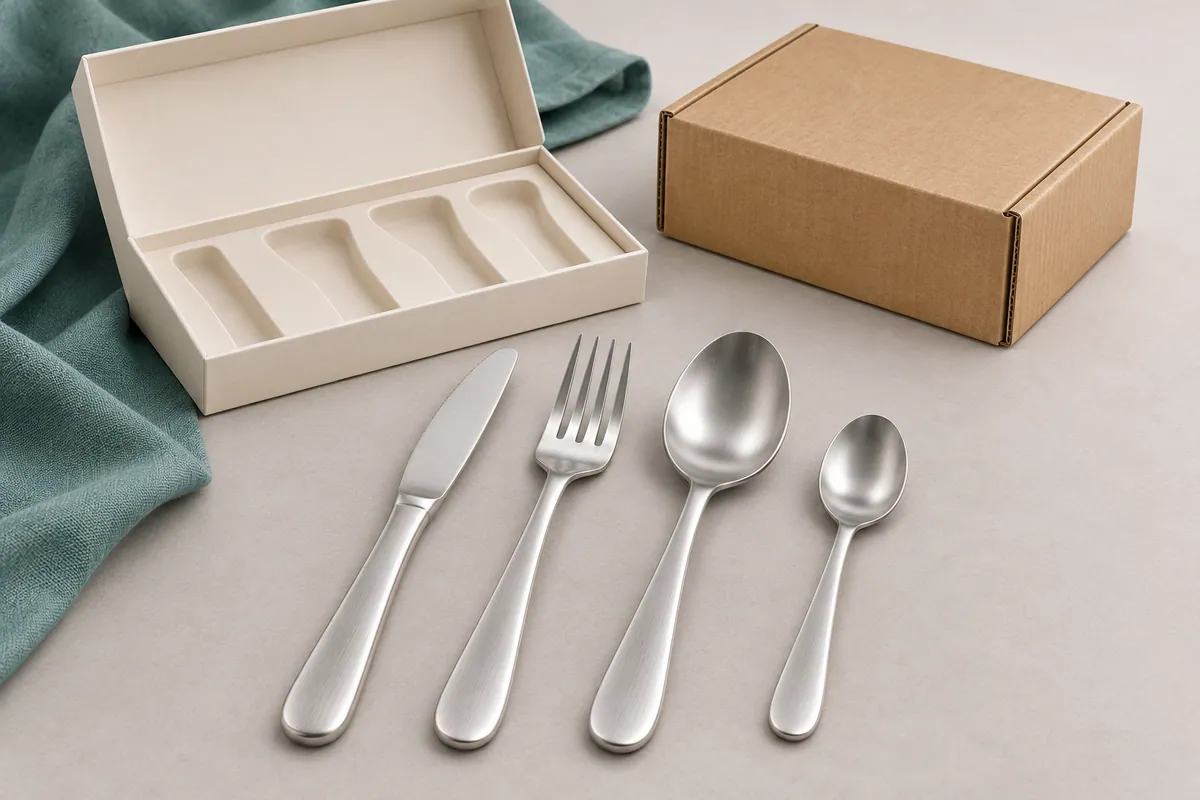
For a Netherlands flatware launch, first separate sales to Dutch consumers from stock held for onward distribution. Then specify the contents, presentation and delivery cost of each retail unit. An import total is not a domestic sales forecast; a low-priced spoon or fork is not necessarily economical to ship alone.
This study is for large supermarket buying teams and e-commerce sales companies. Research date: 9 November 2026, Asia/Shanghai. It combines official statistics and original legislation with 14 public product observations: 13 available online offers and one store-only reference. IKEA Netherlands and HEMA Netherlands supply two substantial physical retail-chain references and two own-webshop channels. These are two overlapping businesses, not four independent companies, and neither pair constitutes a representative supermarket or marketplace panel. No store visit, purchase, consumer survey or laboratory test was conducted. Prices are displayed consumer offers in EUR, excluding delivery; trade values are current USD. The cover is an AI-generated editorial illustration, not a factory photograph, tested product or specific SKU.
1. Demand context: national online growth is not a cutlery forecast
CBS reports September 2026 retail turnover up 2.7% year on year, with volume up 1.8%. Non-food turnover rose 4.6%, but furniture and household turnover fell 0.3%. Online turnover increased 4.5%, comprising 5.0% growth for businesses whose core activity is online selling and 3.7% for the online activity of multichannel retailers. The retail series excludes fuel stations; calendar adjustment and provisional status matter. These are turnover growth rates, not online penetration or stainless-cutlery sales. CBS retail release, 2 November 2026.
The practical implication is to budget separate store and web pilots. Positive national online growth does not offset an unprofitable parcel, and a negative household-retail month does not establish falling demand for a particular cutlery design. Request category sell-through and returns from the intended channel before increasing an order. Those data are absent from the national release and the public product pages.
The Netherlands also has a substantial redistribution role. CBS records EUR319.1 billion of re-exports in 2025, or 48.8% of total goods exports. That all-goods share cannot be applied to cutlery imports. CBS distinguishes re-exports associated with Dutch economic owners from quasi-transit involving foreign owners, and its physical-border series separately identifies transit. Do not merge different statistical bases to manufacture a domestic-consumption estimate. CBS, Dutch Trade in Facts and Figures 2026. CBS physical-border definitions.
2. Three trade years: a mixed product basket with substantial outward flows
UN Comtrade was queried for reporter 528, Netherlands, annual HS2022/H6, imports and exports, 2023–2025, World and selected China, Germany and Belgium partners. The query returned 48 records, 16 per year. UN HS8215 definition, UN HS821191 definition. HS8215 covers spoons, forks and related articles and sets across materials; HS821191 concerns fixed-blade table knives. Neither identifies a stainless-only retail market. Imports are CIF values and exports FOB values; the table is in USD million.
| Year | HS8215 imports | HS8215 exports | HS821191 imports | HS821191 exports | China share of HS8215 imports |
|---|---|---|---|---|---|
| 2023 | 60.326 | 47.079 | 9.245 | 7.441 | 43.40% |
| 2024 | 79.179 | 57.860 | 12.728 | 9.237 | 37.84% |
| 2025 | 68.346 | 55.572 | 10.166 | 8.676 | 45.46% |
UN Comtrade original queries: 2023, 2024, 2025.
The HS8215 import value rose in 2024 and fell in 2025, while China’s value share increased to 45.46% in 2025. China’s selected import flow was USD31.071 million, compared with USD29.963 million in 2024. Germany and Belgium are selected comparators, not a complete supplier ranking. The data do not identify brands, margins, consumer tastes or supplier production capacity.
The USD55.572 million outward HS8215 flow in 2025 is a reason to ask where inventory will be sold, not proof of a particular re-export percentage. It includes exports rather than a separately identified re-export series. Subtracting exports from imports would also mix valuation bases and ignore domestic production, stock changes and timing. Neither that subtraction nor an export/import ratio measures Dutch stainless-cutlery consumption.
All three World HS8215 import net weights are flagged as estimated. World HS821191 import quantity fields use zero with an unspecified unit; that is missing usable quantity, not zero knives imported. Knife export piece quantities are also estimated. Consequently, this report does not calculate a retail-set unit price from customs weight or quantity. The selected aggregates need a narrower national tariff classification and an actual product specification before they can guide a shipment quotation.
3. Local offers: compare exact contents, channel prices and pack data
The physical networks are documented by the retailers’ own store directories. IKEA NL stores, HEMA NL stores. All observations below were captured from current local product pages on the research date. Both retailers describe these items as stainless steel, but the captured SKU details do not establish component-level alloy grades. A generic material description is not a laboratory result. All dimensions are listed product packaging, width × height × length, not measured shipping-carton dimensions. HEMA does not publish comparable pack dimensions or weights in these captured pages.
| Offer / SKU | EUR / pieces / configuration | Listed product package, cm; kg |
|---|---|---|
| I1 MOPSIG 16-piece cutlery set / 003.430.03 | 3.99 / 16 / knife/fork/spoon/teaspoon, 4 each | 5 × 4 × 21; 0.50 |
| I2 FÖRNUFT 24-piece cutlery set - stainless steel / 700.149.99 | 9.99 / 24 / knife/fork/spoon/teaspoon, 6 each | 13 × 4 × 23; 0.95 |
| I3 DRAGON 24-piece cutlery set - stainless steel / 900.917.60 | 14.99 / 24 / knife/fork/spoon/teaspoon, 6 each | 15 × 6 × 23; 1.30 |
| I4 MARTORP 30-piece cutlery set - stainless steel / 301.675.07 | 29.99 / 30 / knife/fork/spoon/teaspoon/cake fork, 6 each | 25 × 5 × 34; 1.50 |
| I5 DRAGON Coffee spoon - stainless steel 11 cm / 500.917.62 | 4.99 / 6 / 6 coffee spoons | 9 × 3 × 13; 0.12 |
| I6 MARTORP Knife - stainless steel 22 cm / 105.210.33 | 4.49 / 4 / 4 table knives | 2 × 2 × 22; 0.29 |
| I7 SEDLIG 24-piece cutlery set - stainless steel / 401.553.11 | 44.99 / 24 / knife/fork/spoon/teaspoon, 6 each | 16 × 7 × 26; 1.45 |
| I8 IKEA 365+ 56-piece cutlery set - stainless steel / 903.997.50 | 54.99 / 56 / table knife/fork/spoon, teaspoon, dessert or salad knife/fork/spoon, 8 each | 26 × 6 × 29; 2.91 |
| H1 16-delig bestekset sydney / 09905120 | 32.99 / 16 / knife/fork/spoon/coffee spoon, 4 each | Not published |
| H2 bestekset Copenhagen rvs gehamerd 16-delig / 09903035 | 39.99 / 16 / knife/fork/spoon/dessert spoon, 4 each | Not published |
| H3 16-delige bestekset valencia / 09905062 | 16.29 / 16 / knife/fork/spoon/coffee or tea spoon, 4 each | Not published |
| H4 16-delige bestekset Bari / 09904420 | 56.99 / 16 / knife/fork/spoon/coffee spoon, 4 each; unavailable online reference; store availability unverified | Not published |
| H5 gebakvork Bari / 09904407 | 3.09 / 1 / one cake fork; order in multiples of 2; minimum 2, EUR6.18 | Not published |
| H6 nijntje gebaksvorkjes rvs - 4 stuks / 60410120 | 4.12 / 4 / 4 Miffy cake forks; promotional price | Not published |
IKEA’s structured offers show online availability, but postcode and selected-store delivery still need checking. HEMA Bari H4 is not available online and is retained only as a store-only price reference; no branch stock is confirmed. It is excluded from the 13 available-online observations. HEMA’s current delivery wording gives 1–3 working days, subject to the order and checkout. Packaging materials and supplier master-carton data remain unknown for both chains.
Three details change a buyer’s comparison. DRAGON I3 displays an online EUR14.99 price alongside an in-store EUR11.99 offer while stocks last; the table uses the online price. Bari H5 is EUR3.09 per fork, ordered in multiples of two, so its minimum goods subtotal is EUR6.18, not EUR3.09 for a two-pack. Miffy H6 currently shows EUR4.12, with EUR5.49 as the former price. Old cached descriptions or crossed-out prices are not substituted for the current observation. H6 is a licensed-character design reference, not permission to reproduce that character.
4. Assortment implications for supermarkets and online sellers
For a large supermarket, the observed 16-piece four-person and 24-piece six-person formats offer a useful starting comparison. MOPSIG at EUR3.99 and FÖRNUFT at EUR9.99 are visible entry-price references; HEMA’s Valencia, Sydney and Copenhagen offers demonstrate different price positions within the same 16-piece count. This is a shelf-price comparison, not evidence of equal weight, finish, durability, margins or sales. Do not promise to beat a retail price before obtaining the actual cost and specification.
The Copenhagen set contains dessert spoons, whereas several other four-type sets contain coffee spoons or teaspoons. MARTORP’s 30 pieces add cake forks; IKEA 365+‘s 56 pieces cover seven utensil types for eight people. A front-of-box count should therefore be accompanied by a type-by-type contents illustration. We recommend testing a simple core set and one clearly differentiated upgrade, using the retailer’s own shelf-space and sales evidence to choose the quantities. This is a proposed buying test, not a proven Dutch preference.
For e-commerce sellers, the separate spoon, knife and cake-fork offers support testing replacement or add-on purchases. But small goods subtotals can be dominated by delivery. H5’s page shows EUR3.95 home delivery and EUR2.95 collection: a minimum EUR6.18 goods order would total EUR10.13 with that displayed home-delivery charge, before any checkout-specific change. This is a transparent illustration, not a verified checkout or supplier margin model. Consider complementary bundles only after checking the platform’s own fees and fulfillment rules.
The IKEA product-pack information also makes dimensional diligence possible: I2 is 13 × 4 × 23 cm, 0.95 kg, whereas I8 is 26 × 6 × 29 cm, 2.91 kg. Neither is a carrier-rated shipping parcel. Obtain the outer carton, protective insert and packed gross weight before comparing freight. For HEMA-like presentations, the missing package measurements are an RFQ input, not grounds for copying IKEA’s dimensions onto another design.
5. Compliance: Dutch metal rules require specific attention
The Dutch Warenwetregeling verpakkingen en gebruiksartikelen, consolidated from 29 May 2026 and shown as current at access, contains material-specific rules. Annex A, Chapter IV (Metals) covers metal/alloy food-contact articles, with or without coatings, and sets composition and migration provisions. Paragraph 4.9 explicitly requires a written conformity declaration, referring to EU Regulation 1935/2004 and Chapter 0, paragraph 0.9. The latter provides for the declaration through commercial stages except retail, identifiable products and renewal when relevant changes occur. A buyer therefore should not assume that only plastic articles need a declaration. Dutch regulation, Annex A Chapters 0 and IV.
For the proposed knife, fork and spoon, obtain a declaration tied to the actual components, finishes and intended conditions of use, backed by applicable supporting documentation. Have the competent laboratory map the relevant Dutch migration provisions and test conditions to that design. The national text distinguishes materials, coatings and conditions: it is not a single universal acid-test recipe or evidence that any sampled product has passed. NVWA’s official guidance also identifies the Dutch material-specific rules alongside the EU framework. NVWA food-contact legislation.
| Procurement gate | Evidence to obtain | Practical boundary |
|---|---|---|
| Food-contact safety and manufacture | EU 1935/2004 safety/traceability information, applicable Dutch metal declaration and supporting documentation, GMP controls | Retailer material wording or an unrelated test report is insufficient |
| Dutch consumer-facing information | Responsible operator details, traceable identification and relevant safe-use instructions; Dutch wording where required | Obvious food-use articles have a limited food-contact-symbol exemption, not a general labelling exemption |
| Distance-sale product offer | Manufacturer identity/contact, EU responsible person when applicable, product identification/image and relevant warnings | A product photograph alone does not meet all online information duties |
| Import and packaging | Correct commodity code, origin, customs/date-specific measures, importer arrangements and packaging responsibilities | No flat duty rate, blanket certification or already-effective 50% empty-space rule is assumed |
EU Regulation 1935/2004, Articles 3, 15 and 17, covers safety, information and traceability; 2023/2006 provides the GMP framework. Article 15(2)‘s exemption concerns the food-contact wording/symbol for articles obviously intended for food use. The Dutch Warenwetbesluit, Article 5, requires Dutch for the specified labelling particulars and special-use instructions. EU food-contact framework. EU GMP regulation. Dutch decree, Article 5.
The General Product Safety Regulation 2023/988, Article 19, sets information requirements for distance-sale offers, including manufacturer contacts, a responsible person in the EU where the manufacturer is outside the EU, product identification and applicable warnings. Its Article 2 governs interaction with specific safety legislation: food-contact compliance does not replace assessment of other relevant risks such as sharp edges. GPSR, Articles 2 and 19.
For non-EU purchasing, Dutch Customs explains 6-digit HS, 8-digit CN and 10-digit TARIC distinctions. An HS8215 research total is not a declaration code. Confirm the complete set, origin, declaration date and measures in TARIC, and arrange the appropriate importer/EORI and customs declaration. The tax authority’s import-VAT basis includes relevant incidental costs and duties, so it is not automatically the supplier’s invoice alone. No order-specific tariff, preference or VAT treatment is established by this research. Dutch Customs: commodity codes. European Commission TARIC. Government business portal: customs. Dutch Tax Administration: import VAT basis.
The EU Packaging and Packaging Waste Regulation 2025/40 generally applies from 12 August 2026, but its Article 24 maximum 50% empty-space ratio starts on 1 January 2030 or three years after the relevant implementing act, whichever is later. Do not label that particular threshold an existing 2026 obligation. Gather pack dimensions now and check the applicable phased duties and responsible operator for the actual supply arrangement. PPWR, Articles 24 and 71.
6. Separate a domestic shelf pilot from a redistribution order
A Netherlands warehouse address does not identify the final consumer market. Ask the buyer to split the first forecast into Dutch stores, Dutch online sales and onward sales by destination. Keep each destination’s consumer information, packaging duties and commercial returns process attached to that allocation. The trade evidence explains why this distinction matters; it does not supply the allocation percentages.
| Decision | Large supermarket buying team | E-commerce sales company |
|---|---|---|
| Retail unit | Approve exact utensil counts, visible contents and shelf dimensions | Show the same counts online; distinguish single-piece price from minimum order |
| Margin model | Work from net selling revenue, landed cost, promotions and channel charges | Also include outer packaging, fulfillment, delivery subsidy, returns and applicable platform fees |
| Replenishment | Use store sell-through and stock cover for the approved design | Use fulfilled sales, conversion and net returns rather than listing views |
| Destination | Ring-fence Dutch stores from export/distribution stock | Confirm delivery countries and destination-specific information before cross-border listing |
Build the quotation from product cost + freight/insurance + duty and clearance + testing/documentation + packaging + warehouse handling. Show recoverable import VAT separately from permanent cost and include its cash-flow effect where relevant. Then compare net selling revenue with channel costs. No numerical margin is asserted because supplier quotes, freight, tax treatment, platform fees and returns rates have not been obtained. Use the observed retail offers as reference points, not as a substitute for these inputs.
7. Pilot acceptance should resolve specification and channel risk
For the supermarket pilot, approve a retained reference sample, component-level material and dimensions, finish, type counts, Dutch retail information and a stable identifier before placing the first allocation. Validate the retail box on the intended shelf and compare actual replenishment and return reasons across the pilot stores. Define acceptable performance with the buyer; this report supplies no invented acceptance rate or recommended order volume.
For the online pilot, photograph the actual sale unit and every included utensil, state the minimum order correctly and validate the parcel after protective packing. Record packed dimensions, delivery charge, damage or missing-piece claims and returns by SKU. Test whether replacements are better sold alone or as an add-on. The AI cover in this article must not be reused as evidence of a supplied SKU or parcel test.
Only expand a shared stock pool after both channels use the same approved specification and destination information. A matching piece count is not enough to merge two sets whose spoon types or finishes differ. Separate variants until their bills of materials and quality documents demonstrate interchangeability.
8. RFQ checklist and remaining evidence limits
Request the utensil-by-utensil bill of materials; dimensions, weight and finish; intended repeated-use conditions; component-linked conformity documentation; Dutch label artwork; retail-pack and shipping-pack dimensions; inner/master-carton quantities; identifiers; MOQ and lead time; origin and proposed classification; Incoterm and named place; and replacement/claim handling. State whether the order is for Dutch consumers or redistribution, with destinations listed separately.
This study does not establish national cutlery sales, retail market shares, actual checkout availability, tested alloy grades, product compliance, supplier capacity or an executable landed quotation. HEMA package data, actual logistics costs and destination-specific order obligations remain buyer/supplier verification items. The evidence supports a disciplined assortment and documentation discussion: a clearly described core set for stores, accurate and viable sale units online, and separately controlled onward distribution. It does not support a claim that the Netherlands’ import value is the size of its stainless-flatware market.