
Malaysia flatware procurement: set contents, material claims and channel packaging
· Yumingxing
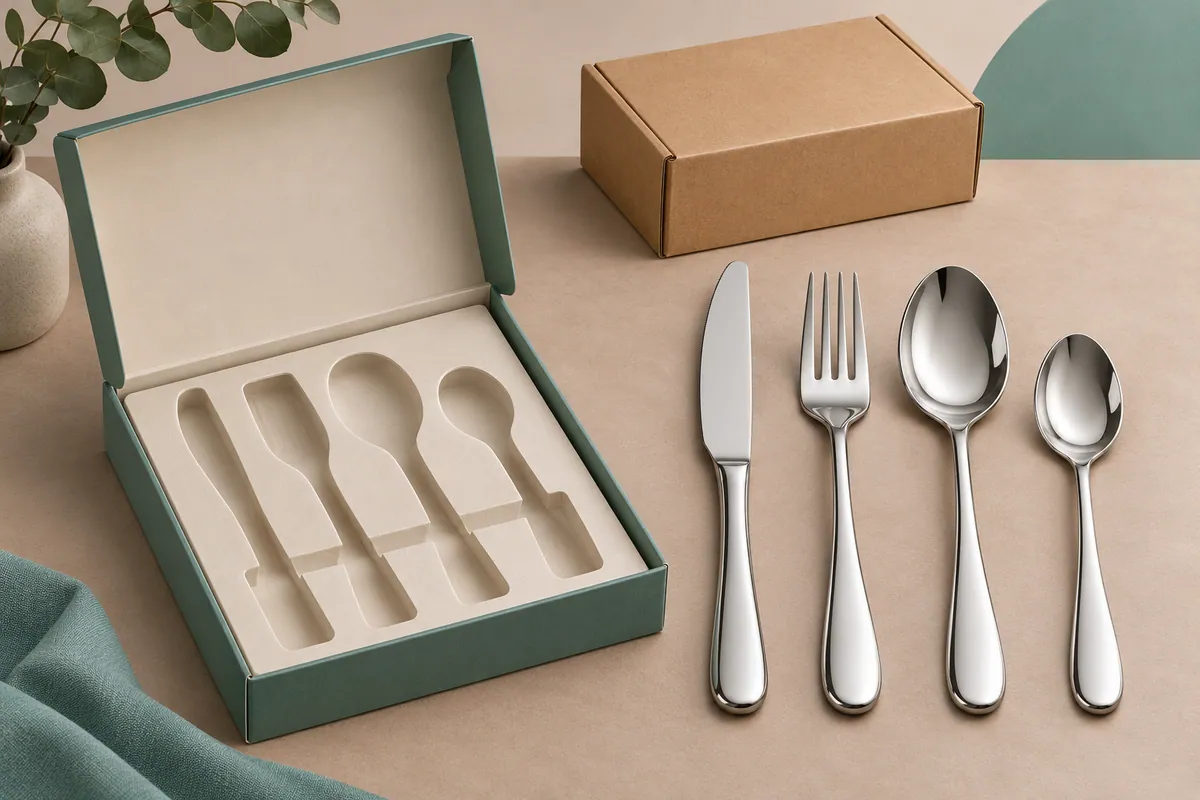
Malaysia’s observed flatware offers support three separate procurement briefs: spoon replacement packs, explicitly itemised family sets, and portable utensil kits. A buyer should compare their contents and delivered packaging before negotiating a price per piece. Thirteen public offers show substantial variation even within one retailer; they do not establish national consumer preferences or sales volumes.
This study is for large supermarket buying teams and e-commerce sales companies. Research date: 6 November 2026, Asia/Shanghai. It is public-source desk research, without store visits, purchases, consumer interviews or laboratory testing. Retail prices are Malaysian ringgit (MYR/RM) and trade values are current USD. The cover is an AI-generated editorial illustration, not a specific SKU, factory photograph or conformity record.
1. Demand context: retail growth is not a flatware forecast
DOSM’s Services Statistics, Fourth Quarter 2025, Table 3, reports retail sales of RM720.751 billion in 2023, RM764.900 billion in 2024 and RM811.513 billion in 2025, rounded from RM thousands. The latter two annual growth rates are 6.1%. These are broad retail sales, not stainless-steel cutlery turnover. DOSM original, PDF page 36 / printed page 27.
DOSM’s establishment ICT/e-commerce release published 30 June 2026 describes reference year 2024, despite “2025” in the publication title. It reports e-commerce income of RM1,288.1 billion, up 8.8% from RM1,184.1 billion in 2023. B2B contributes RM879.6 billion; B2C RM374.7 billion, up 11.3%. Coverage spans five economic sectors, rather than consumer retail alone. DOSM original release.
Do not divide that B2C total by the retail total to manufacture an online penetration rate: the reference periods and measurement populations differ. For procurement, these statistics justify examining both channels, while a store-level trial or the seller’s own conversion and return records must determine the flatware order quantity.
2. Three years of imports: useful sourcing signals, limited material detail
The following are Malaysia-reporter import aggregates from UN Comtrade, HS2022/H6, calendar years 2023–2025, partner World, CIF/current USD. HS8215 includes spoons, forks and other specified kitchen/table articles across materials. HS821191 covers fixed-blade table knives. Neither isolates stainless steel, and their sum is not a retail market valuation.
| Year | HS8215, USD million | China share of HS8215 value | HS821191, USD million | World quantity/weight limitation |
|---|---|---|---|---|
| 2023 | 12.012 | 87.66% | 1.175 | 8215 net weight 7,143,937.813 kg, estimated; knives 2,545,918 items |
| 2024 | 13.199 | 89.40% | 1.292 | 8215 world net weight missing; knives 3,078,285 items |
| 2025 | 14.024 | 81.35% | 1.493 | 8215 net weight 4,727,910.726 kg, estimated; knife item quantity missing |
Sources: 2023 API, 2024 API, 2025 API. Shares and rounded values are our calculations. API zero quantities accompanied by “no quantity” units and null weights are missing, not zero physical imports. Knife net weights are estimated in all three years. These heading/subheading records are flagged as aggregates, rather than individual reported shipment records.
HS8215 import value rose across the period, but China’s value fell from USD11.800 million in 2024 to USD11.408 million in 2025. The selected Vietnam series rose from USD0.072 million to USD0.430 million, while Singapore rose from USD0.145 million to USD0.180 million. These are selected partners, not a complete supplier ranking. They suggest checking alternative sourcing options; they do not prove that Chinese supply is being displaced in the stainless-steel family-set segment.
Do not turn mixed or estimated weights into a target factory price per kilogram. For a quote comparison, use the actual utensil specification, packing list, origin and applicable national tariff line.
3. Thirteen local offers: compare functions before piece counts
Two physical retail chains are represented: IKEA Malaysia and MR.DIY Malaysia. Their respective own webshops provide the two online channels sampled below. These are two organisations with overlapping offline/online operations, not four independent retailers. Online prices are not verified shelf prices. No department-store or supermarket-wide price claim is inferred from these home-furnishing and value-retail samples.
IKEA pages list stainless steel without disclosing an alloy grade for these offers. Availability requires a location/store check; the visible stock widgets said “Checking availability”. Structured offer data identified six IKEA products as InStock and BEHAGFULL as OutOfStock; that product is retained only as an unavailable price/specification reference. The combined sample therefore has 12 online offers indicated available and one unavailable reference, without checkout confirmation. Dimensions below are the retailer’s product-package width × height × length, not a tested courier overpack.
| Offer | MYR | Pieces | Contents | Product package cm; kg |
|---|---|---|---|---|
| MOPSIG | 15.00 | 12 | fork, spoon, teaspoon; 4 each | 5 × 4 × 21; 0.36 |
| FÖRNUFT | 49.00 | 18 | fork, spoon, teaspoon; 6 each | 10 × 4 × 21; 0.61 |
| DRAGON | 69.00 | 18 | fork, spoon, teaspoon; 6 each | 11 × 4 × 21; 0.79 |
| SEDLIG | 149.00 | 24 | fork, knife, spoon, teaspoon; 6 each | 15 × 6 × 25; 1.45 |
| BEHAGFULL — unavailable online | 179.00 | 24 | fork, knife, spoon, teaspoon; 6 each | 15 × 6 × 24; 1.56 |
| MARTORP | 179.00 | 30 | fork, knife, spoon, teaspoon, cake fork; 6 each | 25 × 5 × 34; 1.49 |
| IKEA 365+ | 249.00 | 56 | table fork/knife/spoon, teaspoon, dessert fork/knife/spoon; 8 each | 26 × 6 × 29; 2.91 |
MOPSIG, FÖRNUFT and DRAGON contain no knives. This matters when a supplier proposes to match an 18-piece offer with a completely different utensil mix. BEHAGFULL and MARTORP both list RM179, and both serve six with their stated compositions; MARTORP adds six cake forks. BEHAGFULL is unavailable online in the captured offer data. The same price does not establish equivalent metal weight, steel grade or durability.
The MR.DIY observations below are replacement packs or a portable kit. All had an add-to-cart offer at capture; displayed stock varied and was not independently verified. A case is included with the portable kit. For the other packs, piece quantity is disclosed, while outer dimensions and shipping weight remain unverified.
| SKU | MYR | Pieces | Offer | Material claim |
|---|---|---|---|---|
| 8975485-GRN001 | 2.40 | 2 | Spoon + fork, Green variant, with cover | stainless steel; grade unspecified |
| 9068340-001001 | 11.90 | 6 | Extra-thick spoon pack | stainless steel; grade unspecified |
| 8974097-001001 | 3.10 | 6 | Spoon pack | stainless steel; grade unspecified |
| 8974103-001001 | 3.50 | 10 | Serving-spoon pack; listed length 17.5 cm | 18/0 stainless steel |
| 9068342-001001 | 9.30 | 6 | Teaspoon pack; listed length 13.5 cm | stainless steel; grade unspecified |
| 8972696-001001 | 3.50 | 10 | Floral-design spoon pack | stainless steel; grade unspecified |
The basic six-spoon pack works out at RM0.52 per spoon, versus RM1.98 for the six-piece “extra-thick” offer, rounded. This is a price ladder within the observed assortment, not measured quality: the latter page gives no numeric thickness. Ask the supplier for piece mass, measured dimensions, edge finishing and material documentation before treating “thick” as a specification.
The 18/0 designation is a retailer claim for one listed ten-spoon pack, not a verified chemical analysis. A generic “stainless steel” label does not justify upgrading the offer to 304 or 18/10. Keep those distinctions visible on the quotation and on the sales page.
4. Packaging changes the channel decision
The unavailable BEHAGFULL reference has a listed package of 15 × 6 × 24 cm, approximately 2,160 cm³, weighing 1.56 kg. MARTORP’s is 25 × 5 × 34 cm, approximately 4,250 cm³, weighing 1.49 kg. Thus the latter occupies about 1.97 times the listed box volume while being slightly lighter. These are rectangular-envelope calculations from the linked product pages, not measured freight charges.
For a supermarket, ask how that footprint fits the shelf, hanging display or replenishment tray. The added cake forks may be a useful visible distinction if the retailer can explain it; a larger face should earn its shelf space through measured sell-through.
For an e-commerce seller, obtain the finished shipping parcel dimensions and weight after cushioning. Do not insert product-package measurements directly into the courier tariff. Request quotes by destination/postcode, including Peninsular Malaysia and East Malaysia where the seller intends to serve them, and use the selected carrier’s actual charging rules.
The MR.DIY site showed a delivery promotion for orders below 20 kg and a refund-request window of 7 days, subject to its terms. These are that retailer’s published commercial terms at capture, not a universal freight rate, statutory warranty limit or permission to promise the same terms for a new seller. Confirm checkout conditions before using a competitor’s “free delivery” message as a benchmark.
5. Compliance: separate food contact, online disclosures and import clearance
Food contact. The Ministry of Health’s consolidated Food Regulations 1985, updated through August 2026, regulation 27, prohibits relevant packages, appliances, containers or vessels that can transfer harmful or tainting substances to food or cause deterioration. A stainless designation is not evidence of meeting that requirement. MOH original, page 39.
The 2026 amendment, P.U.(A)48, effective 1 August 2026, includes changes to ceramic-ware provisions and their lead/cadmium release table. Its “flat ware” row concerns the specified ceramic category; do not apply that table as a stainless-steel spoon test limit merely because English retail usage calls spoons and forks flatware. Attorney General’s original, pages 9–12.
Standards and claims. The official preview of MS1458 Part2:2001 identifies a table-cutlery performance standard. The preview explains that Malaysian Standards are voluntary unless made mandatory by a regulator. Its existence alone proves neither a blanket SIRIM certification requirement nor an exemption for the intended shipment. Agree the applicable full standard, edition, material/coating-specific tests and evidence with the importer and testing body; the public preview is not the complete test specification. Department of Standards Malaysia preview.
Online information. The Consumer Protection (Electronic Trade Transactions) Regulations 2024, P.U.(A)449, effective 25 December 2024, require scheduled supplier/offer information in the national language; other languages can be added. The required information includes supplier identity/contact/address, main goods characteristics, full price including relevant charges, payment/terms and estimated delivery. Regulation 5 addresses supplier-borne redelivery where goods are materially different or defective. The schedule asks for safety/health certification where an authority requires it; it does not create a universal cutlery certificate. Original Gazette, regulations 3–6 and Schedule.
For a practical listing, prepare Bahasa Malaysia descriptions of each utensil and quantity, the supported material claim, variant and care instructions; add English if useful. Physical package artwork is a separate approval task. Do not transplant the language rules for imported food labels onto empty cutlery packaging, or assume that translating a listing completes all labelling obligations.
Imports. Malaysia’s Customs (Prohibition of Imports) Order 2023 distinguishes absolute prohibitions, licensing conditions and standards-based conditions in its schedules. Customs instructs importers to check the order and amendments before importing. Match the actual product description, national tariff classification, origin, coatings and any bundled items to the current requirements. Original P.U.(A)117; Royal Malaysian Customs guidance.
This study does not establish a shipment-specific tariff, sales-tax rate, preference eligibility, permit exemption or universal mandatory certification list. Those remain pre-order confirmation items for the importer/customs adviser. An HS8215 market series is too broad to provide them.
6. Separate buying briefs for supermarket and online teams
The following are testable procurement recommendations inferred from the observed offers, not national best-seller findings.
| Decision | Large supermarket / retail chain | E-commerce sales company |
|---|---|---|
| Opening assortment | Test a replacement-spoon pack and one clearly specified family set as different shelf propositions | Use separate listings for replacement packs, family sets and portable kits; do not merge incompatible contents as ambiguous variants |
| Price reference | Use RM3.10/6 and RM11.90/6 as observed spoon-pack references, and RM149–179 for the sampled 24-piece sets; neither is a guaranteed resale price | Benchmark the delivered offer, not only the item price; define promotion funding and shipping charges before setting the price |
| Packaging | Obtain sample retail carton, barcode position, shelf footprint, inner/master-carton quantities and replenishment unit | Obtain packed-parcel weight/dimensions, restraint against rubbing, and a documented quantity check before dispatch |
| Material evidence | Approve one specification and traceable supplier declaration; verify test scope against material and finish | Reuse that evidence in a controlled claim sheet; avoid unsupported 304/18/10, “rust-proof” or certification badges |
| Repeat order | Track sales by store, missing-piece complaints and carton damage before expanding range | Track conversion, delivered contribution and return reasons; separate wrong-content, damage and customer-preference cases |
For both teams, obtain sample approval and quote quantity tiers before choosing the initial order. The evidence does not establish a supplier MOQ, factory capacity, production lead time, acceptable defect threshold or agreed credit term. These belong in the RFQ and written contract, not in a market-size inference.
7. Cost the order and define the evidence still needed
A usable buying calculation starts with net sales receipts minus landed merchandise cost, fulfilment, channel/payment charges, promotion funding and an evidence-based return allowance. Include customs/tax treatment confirmed for the specific shipment, currency conversion terms, local handling and packaging. Retailers should add their distribution-centre/store handling costs; online sellers should add pick/pack, parcel charges and applicable redelivery exposure. No numerical margin or platform fee is assumed here.
Send suppliers an itemised brief: utensil count by type; dimensions and piece mass; declared steel grades for each component; coating/finish; retail packaging and shipment packaging; batch traceability; intended market; evidence and testing scope; quote quantities; origin documentation; lead time and replenishment options. Ask whether the knife blade and other pieces use different materials, rather than requiring one vague grade statement for a mixed set.
Before a commercial decision, close three remaining evidence gaps. First, validate shelf prices and stock with the actual stores: this study captures public online offers. Second, collect seller-specific marketplace fees, delivered prices and return terms if entering Shopee or Lazada. The attempted Lazada page returned a security shell rather than a verifiable offer, so it is excluded; no platform demand claim follows from these own-webshop samples. Third, confirm current product-specific import, label and test requirements with the responsible importer before purchase.
The immediate procurement opportunity is therefore a controlled assortment trial with precise contents and two packaging briefs. Evaluate the result using the buyer’s own sales and fulfilment records before committing to a wider national rollout.