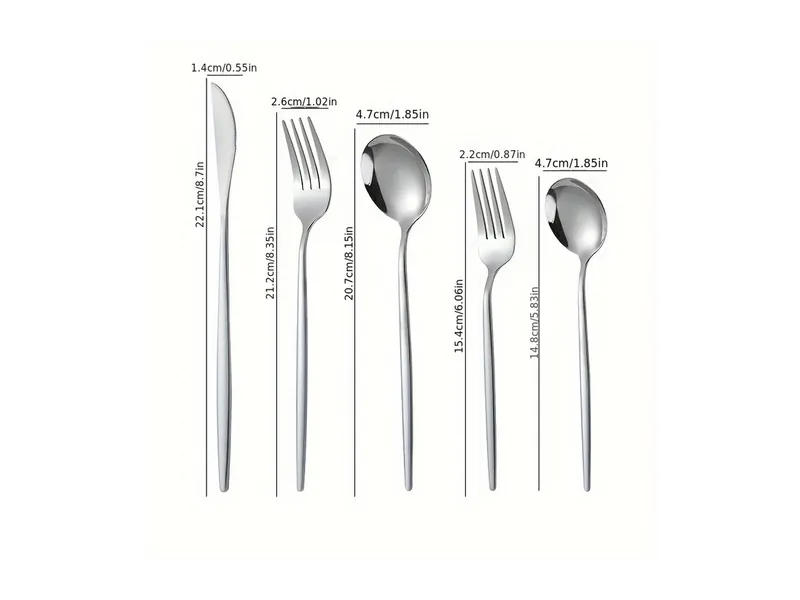
Kazakhstan flatware procurement: family sets, bilingual listings and shelf access
· Yumingxing
Kazakhstan supports a focused trial of household flatware, with 24-piece family sets and small replacement packs evaluated separately. The stronger evidence concerns available assortments, channel structure and information requirements. It does not establish national stainless-steel cutlery sales or a guaranteed selling price for a new brand.
For supermarket buyers, shelf access and local-origin merchandising now deserve attention alongside price. For e-commerce sales companies, a complete Kazakh/Russian listing, actual seller settlement and parcel costs matter more than an attractive national online-retail total.
Research date: 31 October 2026, Asia/Shanghai. This is public-source desk research: no store visits, purchases, interviews or laboratory tests. Product prices are Kazakhstani tenge (KZT); import values are current US dollars. The cover is an AI-generated editorial illustration, not a sampled product or factory photograph.
1. National online trade makes the channel relevant, not the category proven
Kazakhstan’s Bureau of National Statistics reports domestic retail e-commerce of KZT 3,768.8 billion in 2025, including marketplaces. The online share of retail rose from 12.7% in 2023, to 14.1% in 2024, and 14.3% in 2025. Marketplaces accounted for 86% of the 2025 online retail total; retailers’ own websites accounted for 14%. Home and garden represented 12.1% of marketplace goods sales, a broad category that cannot be converted into flatware demand. These figures come from the bureau’s enterprise-based e-commerce statistics. BNS, E-commerce in the Republic of Kazakhstan, 2025.
This supports researching both marketplaces and retailers’ own websites. It does not tell a buyer the share held by any particular platform, the sales of imported flatware, or how much inventory one brand should order. An online sale through a domestic seller also says nothing by itself about where the product was manufactured.
The sample below is deliberately narrow: two retail chains with physical-store references, Sulpak and Kuchenland, and their two separate online shops. The physical and online channels overlap; these are not four independent companies. Sulpak is an electronics/appliance-led retailer and Kuchenland a homewares specialist, so neither substitutes for a census of grocery-supermarket shelves. Sulpak’s Almaty store directory and Kuchenland’s Astana store page establish a physical presence, not stock availability at every branch. Sulpak stores, Kuchenland Astana store.
2. Three-year imports: values are useful, weight needs reconciliation
The UN Comtrade extraction uses Kazakhstan reporter 398, imports, partners world 0, China 156 and Russia 643, annual periods 2023–2025, returned classification H6. The values below equal the returned CIF import values. Weights are net kilograms, not pieces.
| Year | HS8215, world US$ | HS8215, net kg | HS821191, world US$ | HS821191, net kg |
|---|---|---|---|---|
| 2023 | 9,181,942.54 | 2,382,307.17 | 640,508.82 | 84,906.36 |
| 2024 | 6,553,795.63 | 3,811,739.96 | 843,585.24 | 800,650.63 |
| 2025 | 7,739,531.58 | 5,756,893.53 | 623,282.93 | 304,817.44 |
Sources: 2023 query, 2024 query, 2025 query.
HS8215 includes spoons, forks and other kitchen/table utensils across materials; HS821191 concerns fixed-blade table knives. Neither isolates this article’s stainless-steel household assortment. Mixed sets can be classified within 8215 under Chapter 82 Note 3; adding a guessed knife allowance would be inappropriate. Import values also omit retail margins and do not measure consumption or domestic production. EAEU Chapter 82, notes and tariff lines.
The 2025 HS8215 value recovered from 2024 but remained below 2023. China supplied US$6,023,562.34, approximately 77.8% of that heading’s 2025 import value; Russia supplied US$797,132.63. This shows substantial China-origin supply within the customs heading, not a Chinese share of Kazakhstan’s stainless-steel retail market. In HS821191, the corresponding China and Russia values were US$402,761.30 and US$113,056.67.
The weights deserve caution. For example, reported HS821191 imports from Russia move from 7,531.87 kg in 2023 to 481,173.93 kg in 2024, then 2,517.64 kg in 2025. None is flagged as estimated in this extraction, but that does not establish comparability or rule out reporting problems. World rows and four-digit HS8215 rows are returned as aggregates; the partner-level HS821191 rows are reported. Do not turn these weights into piece counts, a market-growth forecast or a supplier target price.
The national statistics portal distinguishes third-country foreign trade from intra-EAEU mutual trade and provides detailed commodity files. Its methodology was checked; the anomalous three-year weight series was not independently reconciled in this study. The Comtrade values are retained as a disclosed trade indicator, not silently “corrected.” BNS methodology, national commodity tables.
3. Shelf access: read the local-origin provision and its exception together
Order 235-НҚ of 14 August 2026 amends the Internal Trade Rules. Its replacement paragraph 49 addresses category 1–4 retail outlets: Kazakhstan-origin food and non-food goods receive at least 30% of trading area and/or shelf space at the subcategory, category and outlet levels, with specified display treatment. It also provides for other goods to fill the remaining designated space when Kazakhstan-origin supply is insufficient, following the procedure referenced in paragraph 50. This is a merchandising provision with conditions, not a 30% flatware-import quota. Amending order, paragraph 49.
An official local-government notice identifies 19 October 2026 as the implementation date. The consolidated legal page retrieved for this review still displayed advance-amendment notes; the analysis therefore uses the amending text itself and flags the consolidation discrepancy. The buyer should confirm the applicable version and shortage procedure with its compliance team before approving a planogram. Official implementation notice, consolidated Internal Trade Rules.
The procurement implication is practical: request a category-level shelf plan and evidence of origin before discussing nationwide shelf quantities. Do not assume that local warehousing, relabelling or local selling makes imported goods Kazakhstan-origin. An overseas supplier should offer a trial assortment the retailer can place within its approved allocation; it should not promise shelf access based solely on a low purchase price.
4. Twelve directly retrieved retail samples
All twelve product pages were retrieved directly on 31 October 2026, with full HTML/text archived. Prices are displayed consumer offers, not wholesale quotations, completed transactions or confirmed delivered totals. Sulpak showed the selected item in stock; Kuchenland showed an add-to-cart offer and pickup information. No checkout or store inventory was independently verified.
In the table, 24/6 means 24 utensils for six people: six each of dinner knives, forks, tablespoons and teaspoons. P is the merchant’s published packaging dimensions in width × height × length order. The retrieved Kuchenland field does not state a unit, so the dimensions are reproduced without assuming centimetres or using them to calculate freight. “SS” means stainless steel as claimed by the seller, not independently tested composition.
| Channel / model | Selling unit | Displayed price, KZT | Seller’s material claim | Packaging information |
|---|---|---|---|---|
| Sulpak Rondell RD-245 | 24/6 | 39,990; reference 48,990 | SS; grade unspecified | Pack construction and shipping size not established; see data issue below |
| Kuchenland Osaka | 24/6 | 41,990 | SS 18/10; gold-colour title | P 20 × 7 × 27 |
| Kuchenland Toscana gold | 24/6 | 89,990 | SS 18/10; gold-colour title | P 15 × 9 × 29 |
| Kuchenland Montreal | 24/6 | 35,990 | SS 18/0; gold-colour title | P 15 × 6 × 25 |
| Kuchenland Manila | 24/6 | 26,990 | SS 430 (18/0) | P 17 × 7 × 27 |
| Kuchenland Hamburg | 24/6 | 35,990 | SS 18/0 | P 15 × 6 × 26.5 |
| Kuchenland Prague knives | 2 knives | 2,990 | SS 18/0 + plastic | P 7 × 2 × 27 |
| Kuchenland Prague teaspoons | 2 teaspoons | 2,390 | SS 18/0 + plastic | P 7 × 3 × 21 |
| Kuchenland Toscana teaspoons | 2 teaspoons | 4,790 | SS 18/10 | P 7 × 3 × 21 |
| Kuchenland Toscana forks | 2 forks | 6,590 | SS 18/10 | P 8 × 3 × 27 |
| Kuchenland Toscana knives | 2 knives | 7,190 | SS 18/10 | P 8 × 2 × 28 |
| Kuchenland Toscana tablespoons | 2 tablespoons | 6,590 | SS 18/10 | P 8 × 3 × 27 |
Eleven observations come from one homewares chain. The KZT 26,990–89,990 span for the sampled family sets is therefore an observed assortment range, not a national price distribution or an entry-price recommendation. Osaka and Toscana gold both claim 18/10 yet have different prices; grade alone cannot explain retail positioning. Gold colour does not establish a coating process or durability.
There are concrete data-quality traps. The Sulpak page lists 1.7 g as weight and 12 × 2 × 27.6 cm as dimensions without establishing shipping-carton measurements. The weight appears implausible for the listed set, but this study does not replace it with a guessed kilogram figure. Its bonus offer is also not deducted from the cash price. Request measured gross weight, carton dimensions and a packaging drawing before costing.
Kuchenland’s care text combines a recommendation for gentle hand washing with permission to use a dishwasher. Preserve both parts when comparing offers; do not reduce this to an unconditional lifetime-performance claim. Obtain evidence for the actual knife, spoon, handle and finish being purchased.
A supplementary Kaspi listing, product 105124430, identifies a 24-piece six-person set, stainless steel and a box/stand, but this review did not retrieve a current seller price and fulfilment offer. It is excluded from the twelve priced observations. Flip’s direct page returned a temporary-service failure. Consequently, this study establishes no verified marketplace price benchmark, commission rate or seller margin. Kaspi specification page.
5. Different buying tests for supermarkets and online sellers
The following are procurement hypotheses derived from the samples, not measured consumer preferences.
| Decision | Large supermarket / retail chain | E-commerce sales company |
|---|---|---|
| First assortment | Test one clearly specified 24-piece family set and a small replacement range, subject to the approved shelf allocation | Test a family-set listing and separately priced replacement packs; obtain live marketplace offers before choosing a competitive target |
| Price comparison | Compare equivalent contents, material evidence, finish, box format and retailer terms | Compare the buyer’s actual delivered price and the seller’s net settlement, including payment/promotion conditions |
| Packaging | Confirm facing width, shelf height, item count, barcode and replenishment carton | Measure the packed parcel; check separation of utensils, protection against scratches and damage, and return handling |
| Information | Match Kazakh/Russian packaging and shelf information to the received SKU | Match both language versions, photographs, quantity and contents to the exact shipped SKU |
| Reorder evidence | Units sold per store per week, stockouts, markdowns and defect claims | Paid conversion, delivered orders, returns, contribution after fulfilment and promotion |
| Reorder gate | Expand only where sell-through and shelf availability support another order | Reorder only after actual settlement and return data support positive contribution |
A replacement pair may have a higher price per utensil than a family set because it serves a different purchase need. Conversely, two inexpensive pieces may be uneconomic to ship alone. Neither outcome is demonstrated by the catalogue prices: both require a channel-specific calculation.
Use a quotation worksheet with goods cost + international transport + applicable import charges + clearance + local handling + inspection + packaging + expected returns, then add the retailer’s or platform’s actual commercial terms. Keep recoverable taxes separate from irreversible costs where applicable. Request these inputs rather than insert an unsupported freight rate, margin or minimum order.
For the first order, ask for a bill of materials by utensil, piece lengths and weights, finish specification, sample approval criteria, packed measurements, carton quantity, production lead time and replenishment lead time. The listed 24-piece formats make contents a sensible comparison anchor; they do not justify guessing monthly demand or ordering a nationwide launch quantity.
6. Language, classification and food-contact evidence are separate decisions
Consumer information. Article 25 of Kazakhstan’s Consumer Protection Law requires consumer information in Kazakh and Russian through the prescribed documentation/packaging/label channels. Its e-commerce provision specifically covers the product name, price and purchase terms, and main consumer properties in both languages. Other listed information includes origin, manufacturer/seller details and completeness where applicable. An English-only supplier sheet is not a finished local listing. Consumer Protection Law, Article 25.
Import classification. The checked EAEU Chapter 82 table lists 8215201000 for other stainless-steel sets at 12%, 8211910001 for fixed-blade table knives with stainless handle and blade at 15%, and 8215991000 for other stainless utensils at 15%. These are published tariff-line references, not a ruling on the sampled products or the final charge payable in Kazakhstan. Set composition, knife construction, coating, origin, applicable notes and the actual import procedure must be checked before costing; taxes and other charges are not included. Chapter 82, pages 1, 8 and 10.
Conformity and food contact. Kazakhstan’s Technical Regulation Law links mandatory conformity procedures to the applicable technical regulations; Article 27 describes a voluntary general-safety declaration for its stated scope. Decision 620’s adult-tableware section lists glass and ceramic categories. It is not evidence that every adult steel utensil requires the same union document. The old national Resolution 367 is explicitly marked repealed and is not used as a current requirement. Technical Regulation Law, Articles 26–27, Decision 620, Chapter 16, repealed Resolution 367.
Decision 299 was also checked in full. Its food-contact provisions and product scopes must be matched to the actual article; Section II item 11 excludes tableware and table accessories from that particular state-registration category. That exclusion does not prove exemption from all safety obligations. This study does not establish a universal clearance route for adult steel flatware, plastic handles or coloured finishes. Have the importer obtain a written applicability determination, identify the relevant testing and document route, and verify any assessment record against the exact product. Decision 299.
Material declarations such as 18/0, 18/10 or “food-grade” are supplier claims, not migration-test reports. The buyer should request traceable material and finish evidence and tests appropriate to the documented intended use. Keep these buyer requirements separate from legal requirements, and do not apply an adult-product conclusion to children’s cutlery.
7. What a purchase decision can use—and what still needs evidence
The evidence supports a limited, documented assortment trial: a family-set offer with an explicit component list, a separate replacement-pack proposition, Kazakh/Russian information and a written shelf or online-channel plan. It also identifies issues worth resolving before a firm order: local-origin shelf allocation, uncertain shipping dimensions, inconsistent weight fields and the absence of a verified marketplace net-price comparison.
Before approving the purchase, close five gaps: the buyer’s actual channel sales and terms; current marketplace seller/price/delivery evidence; measured packing and transport quotations; product-specific classification and conformity advice; and the disputed import-weight comparison. Until then, neither a national stainless-flatware market size nor a “safe” launch quantity can be justified from these sources.