
Germany flatware procurement: set prices, material evidence and packaging responsibilities
· Yumingxing
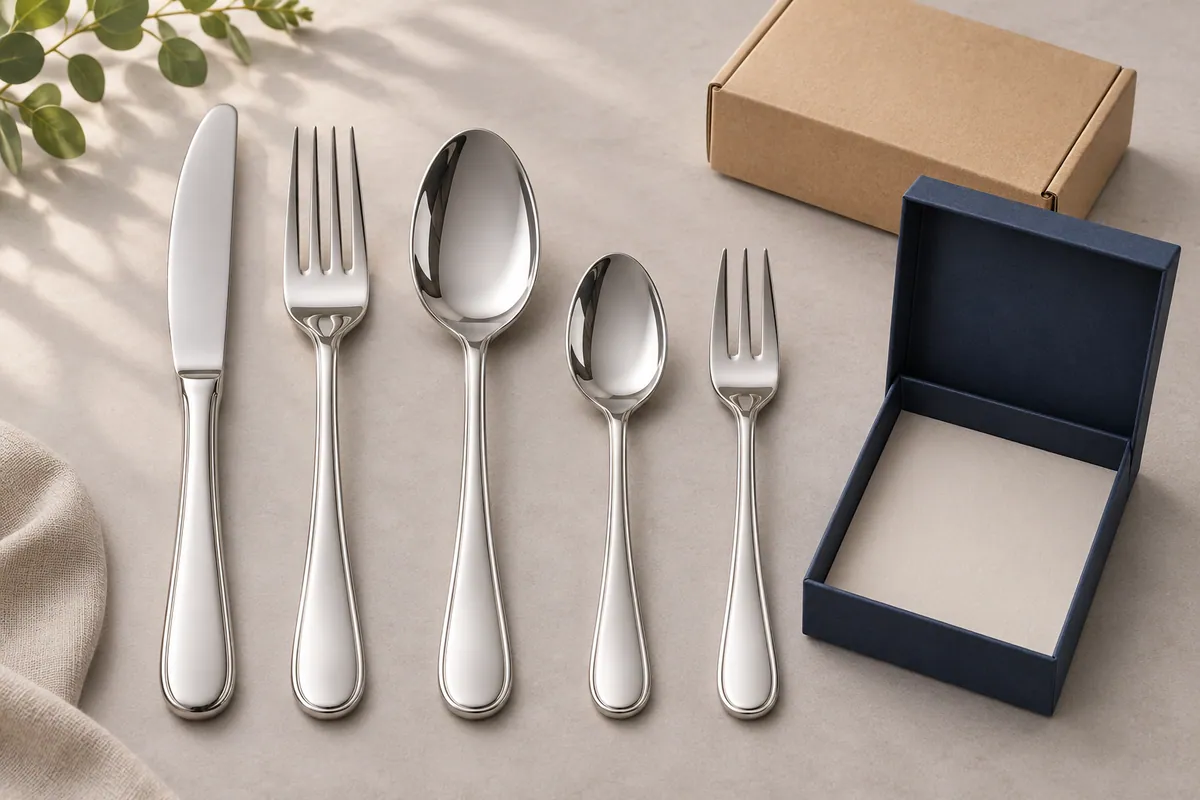
A German flatware quotation should specify the number of place settings, the utensils included, the evidence behind each material claim and who handles the packaging obligations. A low price per piece is an incomplete buying criterion. In this sample, two sets priced at EUR39.99 both serve six people, but one contains extra cake forks and occupies more than twice the listed package volume.
This study is for large supermarket procurement teams and e-commerce sales companies. Research date: 8 November 2026, Asia/Shanghai. It combines official statistics, original regulatory texts and 12 public offers from IKEA Germany and Höffner. It is desk research, without store visits, purchases, consumer interviews or product testing. Retail prices are in EUR, including VAT and excluding delivery unless stated; trade values are current USD. The cover is an AI-generated editorial illustration, not a particular SKU, factory photograph or test record.
1. Demand context: distinguish consumer retail from import value
Destatis’s preliminary annual release reports German retail turnover in 2025 up 2.7% in real terms and 3.8% nominally. Internet and mail-order retail rose 10.1% in real terms. However, the release identifies a structural effect: a large online/mail-order company’s reorganisation in August 2024 added German turnover previously outside the statistics. That makes the growth rate unsuitable as a flatware demand forecast. These figures are the dated preliminary release, not a claim that no subsequent revisions exist. Destatis, 2 February 2026.
The HDE Online-Monitor 2026 puts 2025 online sales at EUR92.3 billion, net of VAT, up 3.9%, with online accounting for 13.5% of its total market versus 13.4% in 2024. The online series concerns B2C new goods, is adjusted for returns and excludes services, streaming and online rentals. It includes physical and specified digital goods. Its definition differs from the Destatis establishment-based series; the two growth rates are not interchangeable. HDE/IFH original report, pages 3–5.
For a supermarket, the implication is to test flatware at store and assortment level, rather than increase the order by the national retail growth rate. For an online company, model net receipts after returns and fulfilment. Neither source supplies stainless-steel cutlery sales, a countrywide best-selling set size or a supplier’s achievable market share.
2. Three-year trade comparison: sourcing context, not market size
The table uses Germany-reporter imports from UN Comtrade, HS2022/H6, partner World, calendar years 2023–2025, CIF/current USD. HS8215 covers specified spoons, forks and other kitchen/table articles across materials; HS821191 covers fixed-blade table knives. Neither is a stainless-steel-only series. Do not add them and call the result German retail demand.
| Year | HS8215, USD million | China share of HS8215 value | HS821191, USD million | HS8215 net weight, kg |
|---|---|---|---|---|
| 2023 | 166.774 | 59.71% | 37.188 | 15,001,906.435 |
| 2024 | 187.877 | 59.34% | 25.039 | 19,668,902.436 |
| 2025 | 204.693 | 59.67% | 31.990 | 17,829,009.897 |
Sources: 2023 API, 2024 API, 2025 API. Values are rounded; shares are calculated from the original amounts. All world net weights shown are flagged estimated. The knife series has no usable item count: zero quantity with unit code −1 is missing quantity, not zero knives. These records are aggregates, not shipment-level reports.
HS8215 import value rose while net weight fell between 2024 and 2025. Because weight is estimated and the category mixes goods, this does not establish a steel-price increase, premiumisation or higher factory margins. China’s share remained close to 60%. Vietnam’s selected value rose from USD32.076 million in 2023 to USD47.681 million in 2025, reaching 23.29% in 2025. Poland and the Netherlands were also queried; the selected partners do not constitute a full supplier ranking.
Germany’s statistical methodology separates intra-EU and extra-EU trade and distinguishes origin from dispatch country. Import statistics normally identify origin; a dispatch route through another European country is a different concept. The customs-border statistical value excludes duties and taxes. This is one reason a European warehouse or reseller address cannot by itself establish manufacturing origin. Destatis foreign-trade quality report, classification and definitions.
Use these data to prepare a supplier comparison, then obtain actual product origin, specification, landed cost and replenishment terms. Domestic production, exports, inventory movements and retail mark-ups are outside this import table.
3. Twelve local offers: piece counts and price conditions
The physical-chain references are IKEA Germany and Höffner. Their own webshops are the two e-commerce channels observed. There are two businesses with overlapping offline and online operations, not four independent companies. These home-furnishing chains provide product benchmarks for supermarket buyers; their assortment is not a representative survey of German grocery chains or marketplaces.
All 12 offers were retrieved directly on the research date. IKEA’s structured offers indicated InStock, but delivery and store availability still require a location check. Höffner showed add-to-cart offers: four had a 2–3-working-day indication, while WMF Palma showed 1–2 weeks. These are retailer statements, without checkout or local shelf-stock confirmation.
In the table, A means six each of table knives, forks, spoons and tea/coffee spoons: 24 pieces for six people. B adds six cake forks: 30 pieces for six people. Package measurements are width × height × length, cm; listed kg, not measured courier billing dimensions.
| Retailer / product | EUR | Pieces / contents | Material claim | Listed package cm; kg |
|---|---|---|---|---|
| IKEA FÖRNUFT 700.149.99 | 9.99 | 24 / A | stainless steel; grade unspecified | 13 × 4 × 23; 0.95 |
| IKEA DRAGON 900.917.60 | 19.99 | 24 / A | stainless steel; grade unspecified | 15 × 6 × 23; 1.30 |
| IKEA SEDLIG 401.553.11 | 59.99 | 24 / A | stainless steel; grade unspecified | 16 × 7 × 26; 1.45 |
| IKEA 365+ 103.997.54 | 39.99 | 24 / A | stainless steel; grade unspecified | 16 × 5 × 23; 1.37 |
| IKEA 365+ 903.997.50 | 59.99 | 56 / seven utensil types, eight each | stainless steel; grade unspecified | 26 × 6 × 29; 2.91 |
| IKEA MARTORP 301.675.07 | 39.99 | 30 / B | stainless steel; grade unspecified | 25 × 5 × 34; 1.50 |
| IKEA PRAKTBOTIA 706.096.12 | 9.99 | 16 / per-type quantities not explicit in captured specification | stainless steel; matte tumbled finish | 14 × 6 × 24; 0.85 |
| Höffner KHG 719, 12530750 | 39.77 | 30 / B | stainless steel; grade unspecified | 25.5 × 5 × 41.5; 1.85 |
| Höffner WMF Palma, 537399 | 59.99 | 30 / B | Cromargan 18/10, polished; retailer claim | 27 × 6 × 44; 2.00 |
| Höffner for friends 709, 536870 | 14.99 | 24 / A | stainless steel; grade unspecified | 13.5 × 5 × 22; 0.95 |
| Höffner Justinus Vito, 10537827 | 47.39 | 30 / B | 18/10; knives separately described as blade steel | 26 × 6 × 43.5; 1.85 |
| Höffner KHG 738, 40533672 | 34.43 | 30 / B | 18/10; table knives 13/0 blade steel | 26 × 5 × 42; 1.40 |
The 56-piece IKEA set contains table forks, knives and spoons, teaspoons, and dessert/salad forks, knives and spoons, eight of each. It is not 56 identical pieces. PRAKTBOTIA is retained with its composition gap explicitly recorded; no serving count is inferred from its title.
Price conditions matter. KHG 719 and 738 display an online customer-card price. WMF Palma and Justinus Vito display promotional prices. Palma’s page includes an offer countdown; the captured price is not a permanent benchmark. Höffner lists EUR5.90 per parcel order for these offers, subject to checkout and its terms. IKEA prices exclude delivery and its stated collection-service fee; a separate store-only promotion must not be substituted for the online offer. Recheck the selected seller, variant and price conditions before placing an order.
4. What the sample supports—and what it cannot prove
The sampled 24-piece sets range from EUR9.99 to EUR59.99, despite sharing the A composition. That spread is evidence of different offers, not a measured durability ranking. Generic stainless-steel descriptions do not prove that the lower-priced set uses 18/0 or that the higher-priced one uses 18/10.
The two EUR39.99 IKEA offers make the composition issue tangible. IKEA 365+ has 24 pieces and MARTORP 30; both serve six. Their listed packages occupy 1,840 cm³ and 4,250 cm³, respectively, so MARTORP’s rectangular package envelope is approximately 2.31 times as large. Its extra cake forks may justify a different shelf proposition, but neither the price nor the piece count proves better value for every shopper.
For supermarkets, test a clearly itemised everyday set against a differentiated set, and measure sales relative to shelf space and replenishment effort. For online sellers, compare the delivered offer and confirm the finished parcel after protection against metal-on-metal rubbing. Listed package volumes are not a carrier’s volumetric-weight calculation.
Material evidence also cuts across price. KHG 738 lists 18/10 plus 13/0 knife steel at EUR34.43, below the EUR39.77 KHG 719 offer that gives no alloy grade. This supports asking for component-specific declarations, not assuming a direct price-to-grade ladder. Retail claims remain claims; this research has not inspected a certificate or tested either product.
5. Food-contact evidence, labels and online information
Regulation 1935/2004 requires food-contact articles not to transfer constituents in harmful amounts under normal or foreseeable use. Article 15 covers identification and relevant use information, with an exception to the food-contact wording/symbol requirement where the article’s intended use is already obvious. Article 17 requires traceability. A fork-and-glass symbol alone is not proof of conformity. Current consolidated text, Articles 3, 15–17.
Germany’s LFGB §§30–31 addresses harmful consumer articles and food-contact requirements. “LFGB” on an offer is not the name of a certificate issued by this research. Ask which material, finish, test method and intended use the supplier’s evidence actually covers. §30; §31.
The food-contact GMP Regulation 2023/2006, Articles 5–7, requires documented quality assurance, quality control and relevant manufacturing records. A buyer’s evidence request should therefore extend beyond a one-page material statement. Current consolidated text.
| Buying claim | Evidence to request | Acceptance decision still needed |
|---|---|---|
| “18/10 stainless steel” | component list, material specification and traceable supplier documentation | identify any different knife steel; agree how the claim will be verified |
| “Dishwasher suitable” | intended care conditions and a relevant durability-test proposal/report | agree conditions, cycles and acceptance criteria; this study supplies no universal number |
| “Food-contact compliant” | finished-article evidence matched to metal, coating, intended foods and use | agree applicable methods and limits with the responsible importer/testing body |
| “Gift-ready” or “parcel-ready” | actual retail box, protective arrangement, packed dimensions and quantity checks | approve shelf appearance and transport protection separately |
For online offers within the GPSR’s applicable scope, Article 19 calls for visible product identification, manufacturer contact details, the EU responsible person’s details when relevant, and required safety information in a language consumers can understand. Other applicable food-contact rules remain relevant; this is not an assertion that GPSR replaces them. Prepare German-facing information and verify responsibilities for the actual supply chain. Regulation 2023/988, Article 19.
No blanket conclusion is made here about every coating, composite handle, children’s product, test limit or required declaration. Those details depend on the proposed SKU. Keep the compliance evidence distinct from promotional language and obtain approval before artwork or listings are released.
6. Packaging and imports: use the rules already in force
The EU Packaging and Packaging Waste Regulation 2025/40 generally applies from 12 August 2026. Article 15 addresses manufacturers’ packaging conformity assessment, technical documentation and EU declaration. Its harmonised material-label timetable in Article 12 starts later—12 August 2028 or the specified implementing-act interval, whichever is later. Do not present every future labelling provision as already compulsory today. PPWR, Articles 12, 15 and 71.
Germany now has the VerpackDG, replacing the former VerpackG. Its §6 addresses registration, §7 system participation for the relevant packaging, and §9 data reporting. ZSVR explains the changed roles and continued obligations. Identify who is the obligated producer for the actual route, including private-label and cross-border arrangements; a carton supplier’s promise does not settle this. VerpackDG original; ZSVR transition guidance.
This creates two separate document tasks: evidence for the cutlery’s food-contact use, and evidence/responsibility allocation for its packaging. Request a packaging material-and-mass breakdown, relevant conformity documents and the party responsible for registration, participation and reporting. Do not merge these into a generic “EU certificate”.
For imports from outside the EU, settle the importer/declarant, EORI, origin documentation and customs procedure. The Commission’s TARIC database brings together tariff and trade measures, but does not include national VAT or excise rates. The broad research headings do not settle a mixed set’s actual classification or duty. EU customs procedure guidance; Commission TARIC explanation.
Shipment-specific classification, origin preference, applicable restrictions, customs value, tax treatment and packaging role remain pre-order confirmation items. No tariff percentage, automatic preference or permit exemption is assumed.
7. Separate procurement briefs for the two audiences
These recommendations are inferences from the observed offers, not national sales rankings or claims about Yumingxing’s tested products.
| Decision | Large supermarket / retail chain | E-commerce sales company |
|---|---|---|
| Initial assortment | Trial a 24-piece everyday set and a clearly differentiated 30-piece option; explain the extra cake forks | Separate listings by utensil mix; show an itemised contents image and text rather than an ambiguous total |
| Price reference | Treat EUR9.99/14.99/19.99 as observed entry references, subject to supplier economics and store trials | Model the delivered price; distinguish customer-card and promotional offers from a repeatable base price |
| Evidence | Approve material, finish, edge quality and care claims against an agreed specification | Maintain the same evidence behind each searchable material claim and safety field |
| Packaging | Approve barcode position, facing, inner/master-carton quantities and replenishment unit | Approve protected parcel, quantity check, actual dimensions/weight and damage handling |
| Replenishment | Use store-level sell-through, stock-outs, complaints and shelf productivity | Use conversion, net contribution after returns, damage/missing-piece rates and replenishment lead time |
An RFQ should state the required utensil dimensions and mass, grade by component, finish, intended use, packaging materials, labelling language, evidence scope, order-quantity tiers and agreed delivery terms. Ask for sample approval, capacity, MOQ and replenishment lead time rather than inventing these from a market report.
For both channels, calculate contribution from net sales receipts less landed merchandise cost, distribution/fulfilment, payment/channel charges, promotion funding and a documented returns allowance. Separate recoverable taxes from economic cost according to the buyer’s actual position. No margin, fee schedule or return percentage is assumed.
8. Evidence limits and the next buying action
The sample is deliberately small and limited to two retailers’ own shops. It excludes marketplace sellers, measured shelf prices, verified sales volumes and completed checkout quotes. Attempts to retrieve XXXLutz and GALERIA directly returned access challenges; cached prices were not substituted into the 12 current observations. PRAKTBOTIA’s detailed contents remain a supplier-check item.
The statistics refer to different populations and years, and Comtrade weight estimates limit unit-value interpretation. Regulatory texts establish obligations, not the conformity of an untested product. Promotions, availability, final shipping cost and shipment-specific compliance must be rechecked before a purchase.
The practical next step is a two-channel sample brief with an itemised contents sheet, component-level material evidence and separate retail/parcel packaging approvals. Use the trial results to decide whether to expand the range. A wider order is justified by the buyer’s own sales and operating evidence, not by treating national import value as a sales promise.