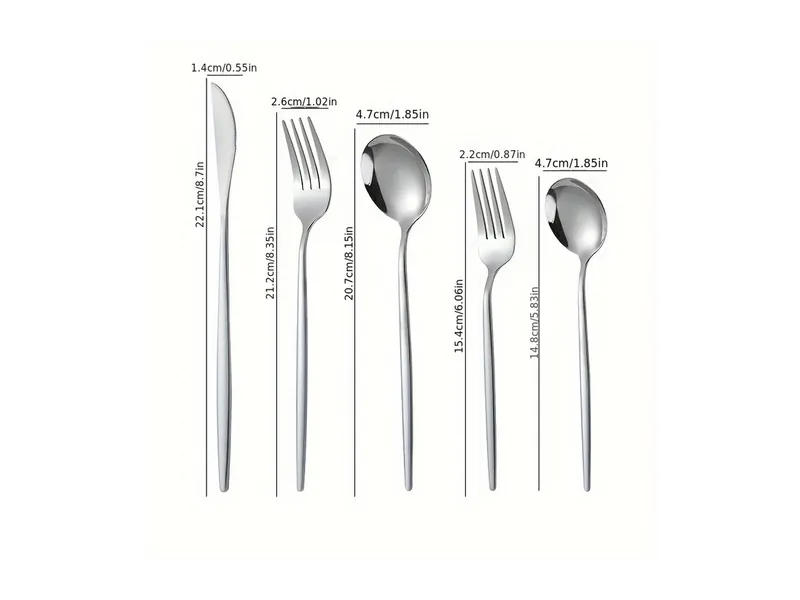
Will This Cutlery Fit the Existing Tray? A Buyer Measurement Sheet
· Yumingxing
The cover is a generated editorial illustration. It is not a Yumingxing product measurement, supplied tray or fit test.
A restaurant, hotel or distributor replacing flatware may already own drawer trays, mobile service carts or divided storage bins. A new knife, fork or spoon can match the desired style but still be awkward to store if its length, bowl width or handle profile differs from the existing pieces. Treat fit in the actual storage opening as a separate buyer decision before confirming the replacement model.
Yumingxing’s cutlery RFQ guide asks buyers to include dimensions or weight requirements when these matter to the project. Its component specification card keeps the knife, fork and spoon specifications separate. Neither a catalogue photo nor a shared set name establishes a fit in a buyer’s own tray.
Record the tray and the utensil in the same unit
Use millimetres or another agreed unit consistently. Measure the usable interior, rather than only the tray’s outside dimensions. If dividers taper or a lip narrows the opening, record the narrowest relevant point. Decide whether pieces must lie flat, stack, or be lifted out by the handle.
| Field | Buyer should record | Decision it supports |
|---|---|---|
| Storage identity | Site, tray/bin reference, compartment and photo or drawing revision | Avoid testing against the wrong fixture |
| Usable opening | Internal length, width and depth at the limiting point | Check the available space |
| Intended load | Knife, fork or spoon; number of pieces stored together | Assess stacking and retrieval |
| Utensil dimensions | Overall length, widest head/bowl, widest handle and profile height | Compare the actual component, not just the set |
| Handling allowance | Clearance needed for fingers, divider edges and routine removal | Avoid a nominally fitting but unusable layout |
| Evidence and owner | Sample ID, measurement method, date and person approving fit | Keep the decision tied to a revision |
The simplest comparison is usable compartment dimension minus the corresponding utensil dimension. A positive result only says that a single measured dimension is smaller; it does not prove that several nested pieces can be lifted out, that a hinged lid will close, or that a differently shaped handle will stack. Leave those decisions to a physical trial with the intended piece count.
Make a sample trial answer a specific question
Ask the supplier to identify the proposed model and component revision. Measure a representative knife, fork and spoon rather than assuming the fork stands in for the full set. Place the intended number of pieces in the actual tray, close any lid, and have the receiving team remove and return them as they would during service. Photograph the limiting point and record a pass, change request or unresolved question for each component. If a tray or utensil specification changes later, repeat the fit check against the new version.
Send the RFQ with the tray drawing or measured opening, the piece list and the required storage arrangement. Ask for the proposed dimensions and a feasible sample route; do not infer fit, price or production availability from a photograph. A clear measurement sheet turns “same size as our current cutlery” into a checkable request.